Showing posts with label Travel in Greece. Show all posts

Sunday, April 8, 2012

Love affair with Crete. ]Palace of Knossos]

Snake Goddess. Crete


Before the age of mass tourism, it was possible to sit on King Minos'  throne, and eat your lunch of sandwiches. How many Athenian boys and girls made this same journey to the Cretan King's Knossos Palace all those centuries ago, we will never know. A journey, that saw their lives end in  devouring jaws of the Minotaur.  This annual tribute of seven boys and  seven girls of course  is pure mythology, but it is pleasing to see that even then, there appeared to be gender equality. But, Sir Arthur Evans' reconstructed palace is very real, and whether you approve of its " restoration" or not is of little importance. What really is rather sad however, is how that open world, has now been confined behind guards, ropes and no entry signs. When I was young, you could wander from room to room, up and down the grand staircases, admire the frescoes of dancing girls and charging bulls. You could  feel, what life might have been like, some three to four thousands years ago.


Early Mimoan house that may have line Europe's oldest Street in Knossos'

                                              
To enter the Queen's bedroom with its en-suit bathroom [who said all these things belong to the modern world]. View its ancient plumbing, her clay bath, and  toilet, complete with other ancient wonders. Still, even today, it is still possible to stroll down Europe's oldest street; built long before the Romans were even thought of, to imagine this street lined with ancient Minoan houses. The cobble stones are still there, slightly worn to a smooth glow.

.

Archaeological site of Phaestos, currently work is going on. This is perhaps the second most important dig on Crete.

Heather and I travel to Crete, as often as finances, and the opportunity allows, with its proud people and checked history. When we first visited the island in our youth, the elders still wore traditional dress, baggy pants and long black boots with an large elaborate silver handled dagger trust through their belt. The civil war had not long finished,  and you felt then that you were standing on the
 edge of the world. Both of us fell in love with this island, a love that still burns bright even today.


Harbour of Agis Galini, along the southern coast from Phaestos.


 This land that had sent troops to the Trojan War, has known  occupancy from many conquers over the centuries. An island that has been fought over time and time again. The Germans during the 2nd World War, the Ottoman Turks, the Venetians, Byzantines, Romans, even Egyptian consorts, each bring their own brand of havoc. The Ottomans and Venetians seemed to take it in turn to conqueror Crete time and time again. Each Turkish occupations saw  half the population perish, with tens of thousands put to death, either through massacres or draconian laws. Over the centuries, this island was a sort of cutting edge between Islam and Christianity, even today one's  belief is taken very seriously.


Chania Harbour looking down onto the quay.


On a recent visit to Crete, we had the good fortune to find accommodation in an old Venetian Palace, at the end of the harbour quay in Chania. Often at night, you would feel a coldness come over the room, even though it was mid summer. It often seemed, that you could feel the presence of departed spirits and souls from the past.

Particularly, when walking down stairs, a rush of cold air would go past despite there being no source whar ever. Once,  Heather felt as though she had been pushed over, our landlord informed us that once everyone in the building had been put to the sword by the Turks. So the palace had a bloody history on more than one occasion. The Christians would persecute the Muslims, who in turn did the same thing back when their turn came. Still, despite its bloody history  Crete is an enchanted world, a  world were everyone is treated as family. The sort of world, that seems to be sadly fast disappearing, bu teven today, all over the Greek islands, that sense of the sacred still lives on. Who knows whether that stranger is a god returning  to the human world for some dalliance.


Minoan Snake Goddess.

Tuesday, November 29, 2011

Road to Ithica.

After a week or so in Salonika we decided to cross the central mountain range to the western coast of Greece .Little did we realise at the time the grandeur of the country  we were about to pass through.  Boarding a rather old bus on the outskirts of town we set out to travel across Greece, hopefully in our quest to discover the lost city of Odyssey when we reached Ithaca. Even today great uncertainty still surrounds the exact location of this legendary Trojan Hero's palace.

A vast expanse of mountain of tops, melting snow and perilous slopes greet the eyes, the sides of which were covered with wild chestnuts and ash forests. Small villages and hamlets clung to the mountain side, often their deep gullies had been turned into narrow terrences to bury the dead. This was the territory so vividly described in many books on the Greek Civil War. Houses perched on hill tops surveying the scene looking for an approaching enemy like an eagle. At times our bus would edge around the sharp corners, as the road plunged hundreds of metres into the abyss, these roads were not built for the 20th cent. Albania was not far away in the distance and my thoughts drifted back to what I knew of the Greek Civil War. I tried to imagine what it must have been like,  the various political factions fighting each other, at times brother against brother,  trying to stay alive in this hostile landscape. The Communists had their route to Albania, while the Nationalist had to dragged their supplies and re enforcements across this wilderness. Then there was the poor peasant families caught in the middle, having to keep changing sides in order to survive. The women abused by one side then the other, it must have been hell on earth.

Slowly the trees turned to pine as the road continued to cling to the mountain side, the now rocky landscape covered in snow stretched as far as the eye could see. Suddenly we were above the cloud cover, basking on a sunlight peak a worthy home for the gods. Such is the road to Ithaca. Gradually we descend after several hours of unsurpassed mountain vista to Ianina on the shore's of a lake before turning south to Preveze. Fittingly we crossed to Lefkada by boat and the realm of Odysseus.
.

Wednesday, November 23, 2011

Thessaloniki-Cultural Capital of Europe


Church of Evangelistria, Thessaloniki.


In 1997 Salonika was declared  Cultural Capital of Europe, an idea developed by the Greek actress Melina Merkouri as Minister of Culture in the Greece. It involved a city being nominated by various National Governments, during the year countries from the four corners of the globe send a variety of exhibitions, musical and theatrical performances, writers and artists conferences to the host city. Salonika as Thessaloniki is commonly called, staged some two hundred individual events throughout the year, so that no matter what time  you visited, there was always going to be some thing worthy of viewing. It would be hard for me to pick and chose what was best, but some events I was lucky to see are worth a mention.


One of the most popular exhibitions would have to have been the treasures of Athos. The morning I visited there appeared to be just about every women in Greece, queueing to view items that are hidden from female eyes. I feared that they must have been disappointed, despite some wonderful Cretan Icons and the large collection utensils that keep the monks company in their hermit like existence on Athos Peninsula. Only males allowed are allowed to visit ,this collection of Greek, Russian and other Orthodox monasteries.


Salonika has a large and diverse mix of nationalities. At the time of independence it was the largest Jewish city in the world, in fact Greeks were a minority. The large populations of Armenians , Bulgarians, Albanians all seem to be represented along with half the nationalities of the planet. This seems to have produced a very handsome population, stunning women and good looking men, all dressed to kill, the result of centuries of hybridisation. Another side effect of this was the numerous exhibitions, theatrical , musical performances during the Festival dedicated to these ethnic groups. The Armenian painting exhibition was disappointing, it was an historical or retrospective survey from 1840 to 1980, the works were all owned by Armenian families still living in Salonika of which there seemed to be a large number.


The Museum of Modern Art proved to be a surprise, the building being a work of art in itself not that you could tell from the outside. The interior however was consisted of a large light well raising three stories with a green glass staircase in the middle. The floor itself was also glass exposing sections of  Roman and Byzantine   
walls and foundations. The bottom of the staircase rested on a marble plinth and occupied about one third of the floor space. At each floor galleries radiated out like spokes of a wagon wheel, these were of a more conventional nature. One was exhibiting the work of a Greek textural artist of the Tapie type. He had started  working in a gestural style in the 50's and then developed through the use of shadow to his current photo montage work. Another exhibition nearby was Goya's war etchings the details at times being hard to view.

Umbrella Sculpture. Symbol for Thessaloniki Cultural Year.


Saloniki's Harbour frount with the unbrella sculpture.


This multi cultural identity became the main theme and symbol for Salonika's year in the sun.
Large sculptural umbrellas were commissioned to run around the harbour boulevard, these symbolised the shelter the city has offered to displaced and homeless people over the last two thousand years. They were very beautiful and most appropriate. In a strange way Thessaloniki is not a Greek city, but has gone beyond this definition. As Alexander the Greats city ,this is also appropriate, as he was the first world leader to suggest the natural unification of humans kind. He ordered his officers to take foreign wives in order to integrate all the different nationalities of the world into one. Unfortunately the policy did not survive his death  subjecting the world to centuries of war. The harbour's edge had been used to exhibit some fifty large outdoor sculpture , but once again the work was somewhat uneven, but some of the figuretive work was of a higher order.


"Nude". Outdoor sculptural exhibition.


The evenings were taken up with theatrical and dance performances. One that still remains in my memory was the Nroirayya Sinthese an Athenian modern dance group, who performed a series of related dances focused on what one would call women's issues. Rape, child birth , violence and so on, the impact was very stark and dramatic and studding with a minimum use of stage setting support. Before leaving Salonika year  I should mention one of the public sculpture dedicated to the death of university students killed by tanks during those dark days of the rule by the army junta. I believe they were holding a march when the tank much to everyone's disbelief ran over them. People today still leave flowers at this site.


"Martyrs for Freedom"


One evening Heather and I discovered an old Turkish Haman, now a fish taverna. The establishment had an array of wine barrels suspended on the back wall. Each had a plastic hose running from the barrel to a tap from which you could refill your wine jug.  Not that one needed to as Greek hospitality kept sending over jugs of wine from other tables when ever they felt ours was looking too low. This establishment seemed to attract all sorts of characters who from time would start to play Rebetica music at a moments notice. It was not dissimilar to an Irish pub were anyone could start to entertain. We spent the evening with a couple of young Greeks who were still arguing over the outcome of the Peloponnesian War. this is one of the great qualities of  the Greeks, time stands still, so that it is possible to become passionate about events that took place several thousand years ago. There is a saying in Greece, when you have three Greeks you have two parties and one break away group.This is what makes the country such a delight.


Friday, November 18, 2011

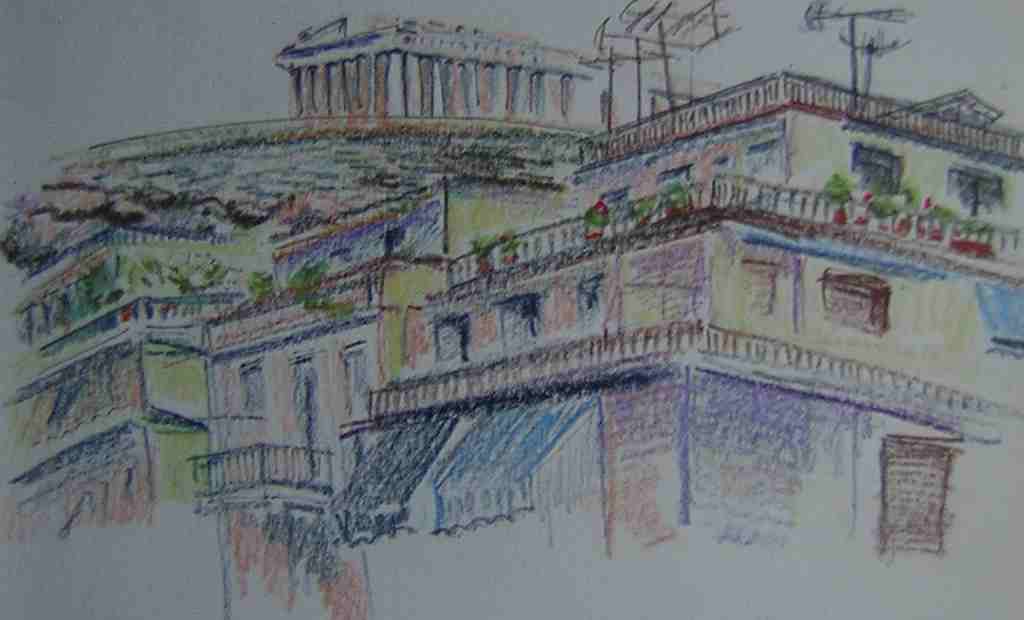
Athen's Plaka District.


View from the Australian Archaeological Hostel, Athens.
Coloured pencil, Peter Kreet.


The first night I spent in the Plaka district of Athens several years ago, I wrote what one could call a pose/poem.

Sound of a  cat's wail and hiss at dawn,
dogs bark amongst
the sound of rumbling garbage trucks welcome dawn.
Laying in bed, listening,
to bottles roll across the cobble stones,
broken glass mixed with  night's memories.
Lets' spend another evening within the district's embrace.
Standing at the window, watching dawn's fingers
marble the Attic sky
unchanged in their slow dance across time,
since Homer first cast their part
a thousand years, no two, three have passed.
Mingled voices raise from street below,
then melt into the soft drone of
an engine as it slowly edges across the city.
Light grows sharper, voices  stronger,
loud motor cycles punch the soft warm air
to jolt memory towards other thoughts.
Athens has a presence that must be felt to be understood.


Plaka, old Turkish Quarter of Athens.
Watercolour sketch. Peter Kreet


Athens is not everyones' idea of an ideal city, but with such a history and mythology it is hard for any visitor not to be moved. Captured by the Ottoman Turks in 1456, four hundred years passed before the skies cleared. On  independence it was little more than a country town, its Acropolis in ruins, it required knowledge of the past to hope for a better future. The Plaka is the oldest part of Athens, the old Turkish quarter.at the foot of the Acropolis. Despite the tourists ,the Plaka offers the visitor a lot in atmosphere and history. As recently as the 1970s , its' cafes and bars offered refuge to students during the rule of the Generals. All had secret exists at their rear to allow escape in the event of a police raid. I always make a point of visiting some to hear rebetica  music in these establishments, the bouzouki music of protest and sorry made famous during those times by Theodorakis and other composers. Music that the Asia-Minor Greeks brought with them from Smyrna's nightclubs with their repertory of songs about hashish-dens, gambling, prostitution, theft etc. This bouzouki  music was given fresh life in the 60's and 70's,  Maria Farantouri was in full flight along with many young composers. These songs rallied the students and Greeks in general to resist the torture and disappearances of so many during these dark times.

Athens is full of contradictions, its modern population arrived after the First World War ,in 1922/3 when the Greek population of Turkey was exchanged for the Turks still living in Greece. The result is a rather ugly modern city over laid on an ancient one. Houses were needed in a hurry. Still there is the Acropolis and many fine museums specialising in Antiquity. You may stroll along the Agora, where Socrates corrupted the city's youth, rebuilt by the Americans and now used as a study centre. The patterned shadows at certain times of the day create works of art on the marble floor.


Agora, Athens [ ancient market]


Between my drawing trips around the city I would discover many interesting dens and galleries. One that particularly took my fancy was called The Centre for Hellenic Tradition on Pandrossos Street, Plaka, a Greek version of an Irish Pub. The owner had taken upon himself the responsibility to save the traditions and folk art of the Greek Island before they were swept away by the tide of modern day tourism. Musician would drop in at anytime of the day and play bouzouki music, some would sing. Various groups would take turns at performing, while many patrons of the establishment would dance among the tables. It was a great atmosphere, drinking strong local wine or ouzo and eating traditional snacks. The music was very impromptu and seemed to drift up into the air in the manner of a column of smoke, not unlike Zen mediation music, just a single note moving through space.


I used to stay at the Australian Archaeological Institute at Athens hostel, a voluntary organisation that funded archaeology digs and scholarships to Australian students interested in the ancient world. Anyone living in Australia may join for a small annual fee and use the hostel when ever they visit Athens. At the time I was in Athens to meet up with Professor Alexander Cambitoglou ,who was responsible for the foundation of the Institute.  At the time he was in charge of the Classics Department at Sydney University and had embarked on this most ambitious project. Australia had not been all that interested in the ancient world, no doubt they felt it was all too far away. On this evening we were going to dine at the Athenian Club a very conservative establishment. Unfortunately the only jacket i had with me was a leather one which proved to be too outrageous for the guardians. Still we found a very pleasant restaurant in a Plaka lane, one needed a guide to find it. The wall were covered with dozens of folk paintings from ever corner of the country and the food was some of the best I had found in Greece. It just shows that sometimes the impressive places are not always the best.


Church of Ayioi Apostoloi, Athens. Peter Kreet.
This is the oldest Church in the city.


Sheep's Heads. Archaeological Museum, Athens.

At times I would spend many hours looking at the Orthodox Icons in the many Churches. The Church of Ayioi Apostoloi has many fine examples, along with many other Churches. At other times I would draw the various exhibits in the museum. I have found this practice very beneficial over the years and the references and notes rewarding. My interest in the past has always been central to my life, as a child I was told that if you did not know where you had been, you could not possibly know where you are heading.


Peter Kreet.  Plaka District, Athens.