Showing posts with label Travel Asia. Show all posts
Showing posts with label Travel Asia. Show all posts
Friday, November 15, 2013
Penang, revisited, a second look.
Penang, on a more positive note is renowned for the quality of it's kitchen. The large and varied menus available would satisfy most food fanatics .Restaurants, cafes and many food markets offer many specialist and personal dishes. The " old town" which is still mainly in tact is unfortunately in a state deterioration and in need of some serious maintenance. I was told by a local that they did not want renovation, but rather restoration, an entirely different outcome. The last thing they wanted was a Melaka make over were the tourist is king. Much renovation results in a façade with a new building behind. To restore something you need to use original materials and techniques, not new plastic or incompatible material laid over the old. The Blue Mansion should be the model.
This central old town classified as heritage badly need attention. I believe rent controls and other unhelpful government measures, designed to stop demolition are a major draw back. Unfortunately this results in a total lack of maintenance by owners that naturally results in run down buildings. Given that this area is now classified as protected, and provided there is no political corruption there must be some way to encourage owners to repair and paint these structures and not demolish them if given the chance. It could be some tax incentive is required.
This is not a unique Penang problem, excessive greed is world wide, but it does offer the opportunity for some creative thinking on the part of the government in addressing the problem. Strong and honest government should be able to solve many of these difficulties. The city is more than worth the effort, so Penang can truly call itself the Pearl of the Orient.


Thursday, November 7, 2013
Penang Island, Malaysia
We are finally on the road home after some three months of travel. I'm not sure if it is old age, but I am starting to look forward to that last air journey. I last visited Penang in the early 1950's during the time of the political struggle by the communists, when the survival of Malaya was very much at stake. I was quite young then and everything was an adventure. It was not hard to see that life here and in Singapore was hard for the local population. How have things changed? Well Singapore speaks for itself, a first world economy and continually goes from strength to strength. How about Malaysia, has the same progress been made. I can only speak as an outsider and express a view as such. there is no doubt much has been done, but I am not sure enough focus is being directed to improving services. I'm talking about tourism now as I am not qualified to discuss the Malaysian economy in general terms. Tourism should be a strong focal point to draw in foreign exchange, but I have found too many people intent on the selling and not enough on service. Penang has many attractions, but they are too often poorly developed, often sit in what to some may be described as a garbage dump. You would think that the Botanical Gardens would have a proper cafe to have lunch. That restaurants would be more interested in selling their food than beer, that money travel cards would be an accepted means of payment and cash withdrawals from banks would be possible. Such facilities are available in Armenia hardly an economic power house. Sadly not in Malaysia, I have tried several banks to no avail, often spending a day to retrieve my card after the ATM machine has swallowed it. Tourists all over the world use debit cards why not Malaysia. I could go on, but if Malaysia wants a tourist industry they need to improve their act. Luckily I had some euros in my pocket as otherwise I would have been stranded here without any cash. There are however some bright spots, people are trying to preserve their heritage and I wish them well. I do not wish to sound negative, but Penang has been a disappointment. Hopefully things will improve.
Friday, October 19, 2012
Buddha Park
 |
| Looking towards the river, Buddha Park. |
Buddha Park.
Sometimes you find
yourself caught up in a series of events without control . My bus ride to the Buddha Park
outside Vientiane was one . Arriving at the bus station ,simply to enquire about
the time table, I was suddenly bundled through a crowd of Tuk-Tuk drivers and bus passengers onto a
bus marked Thadena Road. Before being
able to explain why we were there, we found ourselves on a bus heading out of
town. The bus had been hailed by our helper as it was pulling out of the station.
Anxiously, I asked the conductor to let us off on arrival at the Buddha Park,
she assured me everything would be fine.
Eventually, we arrived
at the Friendship Bridge, a road link across the Mekong to Thailand. On
alighting, we were whisked once more by a friendly Lao to a very old bus that
had seen better days. Our assistant this time told me not to pay more than
12000 kip. This may sound a lot, but in
fact was only $1.50. During the next twenty minutes ,we were treated to a
display of pot hole avoidance The dirt road was used by many heavy trucks, and
had deep pits and gullies every few metres. The springs of our old bus also
were in need of urgent attention, we spent a greater part of the time air born
above its torn and battered seats, hanging on as best we could.
I have always had a fascination
with what is often called Fantasy Parks, no doubt my interest in using recycled
materials in my work helped .Luang Phu Bouneua
Soulilat, a Lao sculptor of considerable note, created this collection of
sculptures on the banks’ of the Mekong a number of years ago. He claimed his
imagery was inspired by the teachings of a Hindu holy man he had meet in a cave
in Vietnam. Regardless of the origins, this park is the result, and it is quite
over whelming. In all such situations, is difficult to convey the overall feel
of this imaginative undertaking. Dozens of Hindu and Buddhist images , demons
and animals all standing in an open
field .Luang Phu fell out with the
Government in 1975, left the country , and some how
found the energy to recreat another similar
park on the Thai side of the river.
The first image a
visitor meets when arriving at the park, is a large spherical Stupa like
structure. You enter through the large gaping mouth of a demon. Once inside you
follow the circular path around and around to the top. On the way up you may
view an internal chamber through openings to see the independent
diorama within. Each level tells a
different story, starting with hell, then earth, and finally heaven were you emerge
onto the domed roof .Great care is required as you walk around this dome as
several areas are fairly slippery, and the ground seems a long way down. The
low concrete rail wall running around the edge does not give great confidence.
Despite my vertigo, I
decided to make a number of drawings of the park from the roof, some of which I
have included here. Most sculptures were of Buddha, and various Hindu Ramayana characters
.The whole collection is extraordinary, even with the assistance of amateur
artists under Soulilates’ direction the park must have taken many years to
build. This eclectic collection, also includes elephants, crocodiles, enormous insects, along with vestal virgins dancing on
giant coiled cobras. Most of these sculptures have been constructed with an
internal brick core, then rendered with concrete and have tool textured surfaces. Others have been built over
metal armature, that is also rendered with concrete. Unfortunately, many works
have not been well maintained resulting in missing arms, legs, and serious
fractures in the concrete.

When I first read
about this park, I imaged Luang Phu had created a critical vision of Buddhist
and Hindu belief, but in fact the park has a strong religious feel, and many
locals pay religious respect to the various images. At the far end of the
meadow, past a large reclining Buddha running down one side of the park, there
is a small cafe that serves lunches. The day we were there a young musician was
playing plaintive music on his flute under a banyan tree. Both visitors and the
contented cows grazing at the river’s edge much appreciated his efforts. It seemed to create an atmosphere
of a harmonious and peaceful world.
Friday, October 12, 2012
Night arrival in Kuala Lumpur
Night Impression of Kuala Lumpur.

Arriving in a new city in the middle of the night, often
engenders a sense of excitement. An unknown, hidden behind walls of darkness, broken only by the random
cry of brilliant lights. All the colours of a rainbow, spreading out, twinkling
in a tapestry of patterns. Speeding through the dark from airport to hotel,
your eye and mind only see the brilliant floral display of colour without the
distracting presence of any ugly sight. Kuala Lumpur seems dressed for some
great occasion, its’ public parks and streets dressed in Sunday best. Trees
combed with bright coloured lights lead the eye from one delightful vista to
the next. Iconic building clothed in a coloured light show, that travels down
walls and across streets. My driver
informs me it is all for Independence Day later in the week.
The unforgiving light of dawn draws back this wondrous
curtain, revealing the underbelly of reality. Still first impressions remain
strong, fixing themselves in mind and soul, prompting further exploration of
this new world. The urban landscape offers up an extraordinary contrast of old
and new. Adventurous architecture stands shoulder to shoulder like sentries
guarding the past. Buildings with stained tropical cement walls, support rows
of air conditioners that piece their rooftops. Trees and greenery somehow
survive in their elevated position among solar panels, and assorted roofline
additions. All cities from an elevated height offer this exciting canvas to the
eye, and inspire new ways of looking at the world.
Saturday, September 15, 2012
The Asian World of Tuk-Tuk.
 |
| Tuk-Tuk |
Tuk-Tuk that quintessential form of transportation in most of Asia vary greatly in comfort, size ,and price. In Indo-China some drivers go to extraordinary lengths to validify their price demands, often producing fare tables to prove their point. I have found the wandering ones are the best value, those you hail down on the open road. Vehicles out side tourist spots and hotel are a no no. Recently when landing at Luang Prabang after sailing down the Mekong, I needed to load and unload a couple of times in order to avoid some outlandish price demanded by the owner. These drivers have a great advantage for unlike the traveler, know their town and the distances involved giving them a great entrepreneurial advantage, in this case I only needed to go around the corner to my guest house. Here in Vientiane the same seems to apply.
Tuk-Tuks come in a variety of sizes depending on the motorcycle's horsepower. This influences not only the seating capacity, but to some extent the comfort of your ride, particularly over rutted roads.The larger ones may have a "type" padded seat, but these comfort factors don't influence the price, this is always determined by what the driver feels he can extract There are times the rather erratic driving habits require a firm grip on the railings. To fall out would not be a good look as your Tuk-Tuk weaves its way through traffic and pedistarians. Last year while in Phuket prices varied from 200br to 800br for the same journey' so you can see there is considerable flexibility. Not that I feel you need to exploit various situations, after all they need to earn a living. But this is a two way transaction and a fair price needs to be arrived at by a two-way effort.
The decor of these unique vehicles represents their greatest attraction.Many are overall painted in different designs from flowers to abstracts. The important things is the colours must be bright, so as to be noticed. Some drivers I have noticed rig up a hammock in the back to have a sleep while waiting for custom. Others will sit under a nearby tree, no doubt discussing the world economic crises, and the lack of customers. No matter, travelling by Tuk-Tuk can be fun and is a great local experience not to be missed. I have produced a few drawing of these unique vehicles, but will not be able to post them onto the blog until I return home.
Saturday, September 8, 2012
Mekong and Luang Prabang
 |
| Mekong Hills |
There is no better way to approach Luang Prabang than by boat, sailing down the Mekong on the slow boat from Huay Kai. You are lulled into a sense of complete relaxation as you wind your way along the Mekong through a magic landscape of green hills and valleys. They seem to open up before your eyes like the leaves of a picture book. It is best in the wet season , to sail with the swift flowing currents that swirl around rocky outcrops that rise through the dark brown water from the river bed. You pass through whirlpools, eddies and contrary currents for the Mekong has no markers and therefore you must sail in daylight.
Sitting in the bow of the ferry you drift into a state of peace with yourself and the world in general, surrounded by hills of various greens. Hills covered in tropical forest , others with plantings of rice, corn, and hops, the life blood of the hidden villages along the river. Time seems to stand still, so its best to relax and run with the flow.

Typical French Colonial Building, Luang Prahang
Luang Prabang the old town runs the length of the peninsular and has the capacity to carry you back to a distant past, a time of few cars and time to think. Of course this is not for everyone, but as a place to relax it would be hard to beat. Few buildings are more than two stories, built in the French Colonial style of shuttered windows and balconies,streets lined with trees, cafes and bistros. You could walk down the middle of most streets with relative safety. You could count the minutes between cars along streets without the need for traffic lights. This is a lost pre-industrial world.. There is no hurry and everything seems to be done in due course.
I spent a few hours drawing the buildings in these picturesque streets, and walking down such a street it is possible to suddenly find a road that has been blocked at each end with a plastic chairs. Table and chairs on enough settings for 100 people have been set up on the road under canvas, musicians and singers have been hired after all this is the wet season. What is the occasion you might ask, well it could be an anniversary of the celebration of a child's birth or simply people having a mass B/B/Q/ With time people start to dance and enjoy themselves without all the undue regulations so common in the west. It's a bit like stumbling upon Alice's tea party.
It's difficult to convey the sense of freedom, peace and well being without experiencing it. If you haven't been to Laos, put it on the top of your list before it is discovered by mass tourism.

Vat Xieng Thong, Luang Prahang.
 |
| Hmong Village on the banks of the Mekong. |
 |
Mekong banks |
Saturday, August 25, 2012
Malacca's street party market.

It would appear every Friday, Saturday, and Sunday evenings are party time here in Malacca's Jonker district. Thoroughfares are closed, along with narrow connecting lanes to make way for hundreds, no thousands of stalls, road side cafes, and everything in between. A vibrant mass of humanity, shoulder to shoulder enjoying themselves, chocking the narrow street, as could only happen in Asia. Tables and chairs placed randomly along the roadway, while their owners cook up a vast array of unforgettable dishes. People flattening fish through a mangle, or deftly dissecting a chicken with a cleaver. The vitality of all these people is hard to describe. Everyone with their few metres of space have no difficulty co-operating with each other.
Yesterday evening after finishing some drawings of a Chinese Temple, I was suddenly swept up by the crowd unexpectedly. Before I could say Jack Robinson, I found myself in a Chinese Club in full throat Karaoke mode. The singers were quite elderly, but still in fine voice as they sang a varity of Chinese love songs. They were accompanied by a vidio voice and musicians that produced a very professional result. From what I could gather you were able to obtain a CD of your efforts, no doubt to play endlessly to your friends. Then I found myself in the middle of a square dancing class, that looked a little like a high tempo Tai Chi session in some park. The dancers were very earnest and followed their leader carefully. The only thing missing was the cowboy hats, but all seemed to be having a lot of fun as they worked their way around the floor.
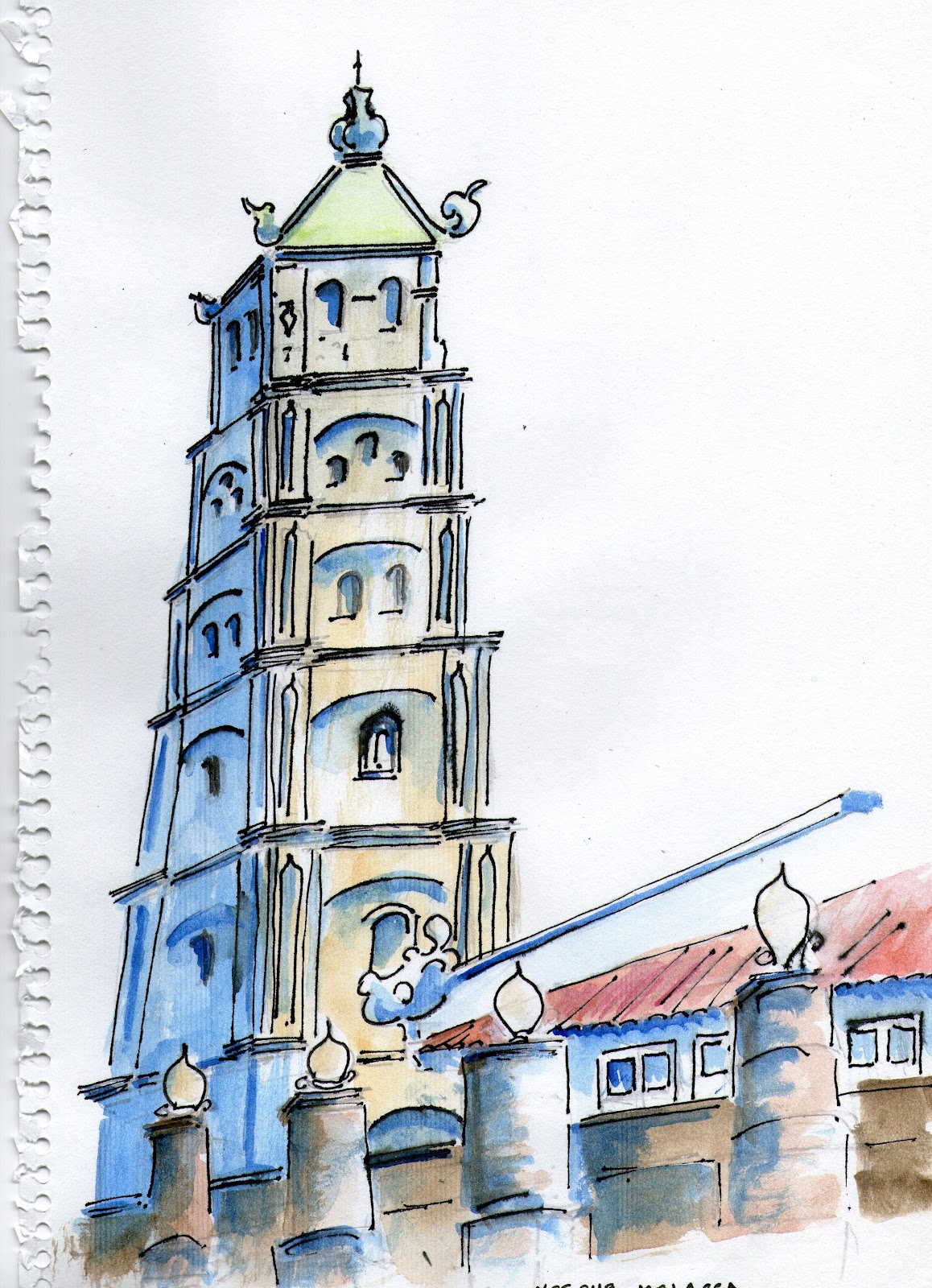
Melacca.
 |
Temple roofline, Melacca. |
Friday, January 20, 2012
Impressions of Hanoi.
Hanoi has the appearance of "Old Asia", streets and back alleys crowded with people squatting, seated on small plastic stools, eating their evening meal from the numerous street cafe. Garbage stacked high in piles were every space allows. The aroma of spice and incense fill the air among a vocal throng. I have always found Asia exciting, both new and old at the same time. The traffic is chaotic to say least, when viewed from above the street scape takes the form a motorised ballet. Scooters weaving between and around each other from not one, but both directions, while they incorporate a U turn here or there. Traffic turning right and left with abandon as bright splashes of coloured clothing stream out behind, while the odd car adds a new dimension.
Crossing the road becomes an art form in itself, simply walk out and trust in God, you are in the hands of a variety of driving skills. Drivers somehow make the necessary adjustment to the right or left to avoid hitting you. Generally they will pass behind, this is important as the flow in one or another direction can mean the difference between life or death. During the first few days we experienced a few close calls, the important thing is never run or stop as this will destroy the rhythm of movement, the dance of life.
The most rewarding experience is the people themselves particularly the young, half the Vietnamese population are under thirty years. They express such enthusiasm for life, confident that their world can only get better. There seemed little bitterness towards the outside world despite the war, the hardship that followed the years of sanctions. It is hard not to admire their fortitude and confidence in the future. When ever I would sit down to draw, a crowd would gather around generally young students keen to be shown how to make pictures. Most were learning English at high school with an almost standard desire to work in tourism when they leave school. This was were they saw the opportunity to earn a good wage. The young girls seemed far more open to the outside world than the boys who were more reserved. They were all full of questions, did I like the food, was I going to teach here, how long would I stay and so on.
Heather and I tend to walk every where, when in a new city. It is the best way to gain the feel of the place, you can put your finger on the pulse of things, discovering new experiences, places, people. The energy displayed by this young population auger well for the future. We shall return , hopefully when Vietnam grants longer visa than their present thirty days.
POEM by VIETNAM'S CELEBRATED WOMEN POET
XUAN HUONG.
"Praise whoever raised these poles
for some to swing while others watch.
A boy pumps, then arcs his back.
The shapely girl shoves up her hips.
Four pink trousers flapping hard,
two pairs of legs stretched side by side.
Spring games. Who hasn't known them?
Swingposts removed, the holes lie empty."
Thursday, October 20, 2011
Phuket, Vegitable Eating Festival.
 |
| Yellow Festival Flags Phuket. |
 |
| Street kitchen Phuket Town. |
The Festival started on the 24 September, the start of my 75th year, so what more fitting occasion could I ask for than to sit here in an open air dinning room listening to a female voices chanting Buddhist chant . They drift through the air, the music has a soft and mesmeric quality accompanied by some form of reed pipes. This chanting was to continue for the next nine day at Kata Country House for the duration of the Vegetable Eating Festival. Their rhythmic harmonic cords follow a repetitive structure up and down. I am not sure whether nine plays any role in the chants, but the number plays an important role in the Festival as it is held in the ninth month for nine days. Tradition holds that nine immortals return to earth each year to assist people who are struggling to lead satisfactory lives.
 |
| Phuket Main Temple, Centre for the Festival. |
 |
| Another Vegan Street Kitchen. |
Apparently in 1825 Phuket suffered from a fever, but a group of Chinese actors under took a fast and were not affected. A Chinese resident named Kang-Si thought thought local religious practice differed from Taoist ritual in China and offered to go to China and search for the necessary statues, items and healing books. The local Chinese collected the money and when he returned on the 7th day of the ninth lunar month with talismans, magic formulas and a sign to place in front of the shrine the Festival was born. It is claimed that disease is caused by bad actions, thoughts and behavior. Fasting expels the toxin from the body allowing good feeling to return. I must say I felt very good after only six days.
 |
| Phuket Temple. |
 |
| Devotees making offerings |
Subscribe to:
Posts (Atom)