Thursday, November 15, 2012

Australian Immigration


                                                    Australian troop ship "Westralia"
 

Immigration

The current hysteria gripping Australia concerning the number of refugees arriving daily by boat, prompted me to recall the events that surrounded my own family migration to this country, after the Second World War.

There was an element of escape about our decision to desert Britain. We had endured six years of war, with its regular nightly bombing,  sprinting down to the bottom of the garden, saucepans on our heads, there was not enough helmets to go round, to reach the air-raid shelter. Past  resident Dad’s Army anti-aircraft embankment and it’s handy source of sand for small boys .

By the war’s end my father was dead, grandfather had lost a leg, and an uncle had been killed in the regular nightly Spit-fire battles near our village. We had the good fortune to live very close South England Air Defence headquarters!

My mother and grandmother were both born in Australia, so they were able to obtain a passage  home on a returning troop ship. The voyage was exciting for a ten year old, pickpockets among the sights and smells of Port Said. Arab boys diving for coins in the Red Sea at Yemen, and the appearance of Neptune as we crossed the equator.

It had been intended that we disembark in Sydney, but at the last moment we were diverted to Melbourne. This was a great disappointment to my grandfather after his years at sea, fighting pirates off the China coast, blackbird native labour for colonial planters on  Pacific islands. He could never make up his mind whether Sydney or Rio de Janeiro  could claim the most specular harbour.

My first impression on arrival was the blinding light, sunglasses were not a fashion item as they are now, so I spent my first few weeks squinting into the distance. It took several days to reach Sydney by train, every state had a different rail gauge, and we obliged to stay overnight in Albury waiting for our connection. The war years had curtailed most infrastructure development, along with housing construction. On arrival we found there were few houses for sale or rent for  that matter which set in trail the series of events that  follow ed. At least we did not have the difficulties of our current arrivals.

Saturday, November 10, 2012

Portraits, what is a true likeness?


Sketch, Vision of Sue, by Peter Kreet


My first example is a quick ink and wash sketch I did a number of years ago, were the main focus was to capture the personality of the girl. It is very rough, but I feel quite lively. After all who wants to see themselves as half dead.


The Love of Portrait.
What is meant by a portrait, a photographic likeness, the capture of the spirit of an individual, realistic  academic painting, impressionist rending, and so on. Everyone has their own idea, and rightly so, after all most will live with the painting assuming that they have commissioned the work. Many artists look on portrait painting as an opportunity to earn a little money. Others may shun the whole idea declaring the practice as archaic, and only undertake the task for close friends or to learn new techniques.
 
Owning a portrait of yourself, has great appeal to many people. You only have to observe the crowds who queue up at the easel of a street artist to have their likeness drawn. Many people are reluctant to sit, fearing that their inner soul will be exposed in some way, or they fall into a type of trance that results in a lifeless portrait. Some artist paint only from a photo with a rather wooden result. Personally I feel this is rather sad, both from an artistic view point and a social experience. A few year ago a good friend of mine George Davis painted my portrait over six months, during which time we not only got to know each other very well, but enjoyed the company.
 

What constitutes a satisfactory portrait? I have taken the liberty to throw up a few possible approaches realistic or otherwise. Historically only people of wealth had their likeness painted generally by an important artist. Many of these works were produced with the artist having one eye on the reaction of the patron, rather than truthfulness. Van Dyek’s portrait of Queen Henrietta Maria comes to mind, according to Prince Rupert’s sister, the lady in question was rather short with crooked shoulders, spindly arms, and teeth that stuck out of her mouth “like guns from a fort”, not that you would  know looking at it. I know artists that feel all this is fine, after all who knows what a person looks like a hundred years or so from now, The important thing is the painting itself, its’ aesthetic, and general appeal, or even in some cases the historic context of the piece.


Joshua Smith 1943 by William Dobell


The portrait of Joshua Smith by William Dobell was much criticised after he won the Archibald Portrait Prize in 1943. Critics claimed the work was a caricature not a portrait, no matter what its artistic merit.

                                                        Morton May by Max Beckmann


In the painting of Morton May , Max Beckmann has been more concerned with the creation of tension within the work, while presenting the uncomplicated view of America. The painting was completed a year before his death. He was sixty-five and gravely ill, he seems to have provided a protective shield in front of the sitter in defence to his own internal illness.


                                           Self-Portrait in Black 1944 by Max Beckmann


The Self-Portrait In Black  by Max Beckmann displays great interest in shape and drama, rather than concern about correct portraiture. It was painted while in exile in Amsterdam for ten long yeards during in Second World War. His endurance seems to be at an end, as he turns in the seat and hurl bitterness and scorn at the world in general. Beckmann painted some eleven self- portraits during his lifetime and to a great  extent tracks his feelings about the world.


                                                      Choir Boy by Haim Soutine.


Soutine’ “Choir Boy”, like the Dobell also has that sense of caricature about it. He appears to be commenting on the petit bourgeois of Parisian  life . His work at this time was somewhat influenced by Modigliani. His colours have both humour and luminosity.


                                          Lunia Czechowska 1916 by Amedeo Modigliani

                                                                                                                                                                                                                                                                       The Modigliani portrait has everything one would desire in a painting. Bold colour, formal design, while pushing the boundaries of restrictive art practice. It has all the qualities of good portraiture, tone, tension ,texture , balance and aesthetic appeal.


                                                     Thomas Carlyle by Whistler.


The last example Whistler’s portrait of Thomas Carlyle allows us to see howl portrait painting has evolved over recent years. Although this work could not be described as a standard portrait, it never the less embodies the conventions of 19th cent. traditions.

                                                   Self-Portrait by Peter Kreet.

 
Finally another quick sketch, a likeness  captured with a limited amount of means. The idea was to capture the essence with as little detail as possible.

Wednesday, November 7, 2012

The artist's life Model


Quick ink drawing.


The Life Model’

 People have all sorts of extraordinary ideas about what takes place in a life drawing class, when in reality a naked body is a fairly impersonal thing. Even with young unscared ones, as the artist is totally focus on the problem of reducing the image to a series of lines, planes, and tones. Every person is unique with or without cloths, and even if they are very beautiful, the erotic is very much of a secondary consideration.

 Many art students at some point in their careers will be asked to pose, often the model has failed to show up, and the group must improvise. Some are only to happy to undress others not so, depending on their background, but this has nothing to do with prudishness. One of the most difficult tasks is to hold the pose as best you can, ten to fifteen minutes may seem like an eternity let alone an hour. Even with breaks in between to recapture the exact position proves difficult even for experienced models. Concentration is required to stop your mind from wandering.

  One of the great life drawing experiences I had was in Desiderius Orban”s art school above the Ship Inn Hotel, at Circular Quay in Sydney. He was a famous Hungarian artist who escaped central Europe in the 1930’s. Like many other Ex-European modernists at the time, he migrated to Australia and through teaching introduced new concepts for painting and drawing. This was never more apparent than in his life class, were ten or fifteen second drawings were often required. He would run up and down the room shouting faster faster. His philosophy was very much that creativity was an instrumental thing and a subconscious response was what true art was all about. Draw from the shoulder he would say. Naturally he had critics, but he always claimed novelty is in itself a work of art, if it is done within the limits of a creative visual imagination. His approach forced students to work freely and forget any inhibitions. This was the best way to give life to your work.
 
Conti sketch.


Monday, November 5, 2012

Vietnam and Lao Masks Art as Ritual.


Art as Ritual, Theatre Masks of Asia

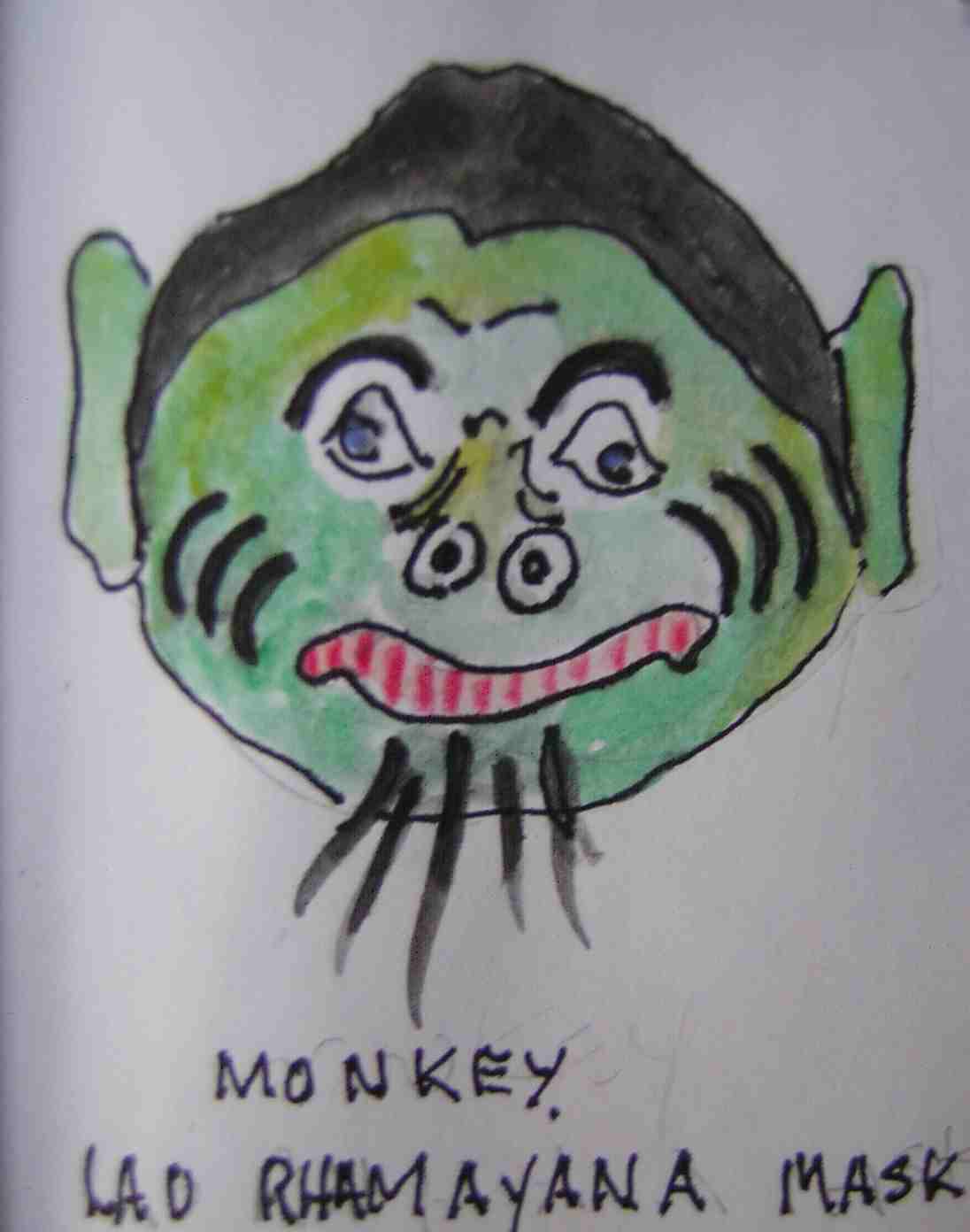
Recently, while walking through the National Museum in Luang Prabang, I came across a collection of theatre masks, and naturally, I quickly made a few sketches to add to my book on Masks of the World. Because of the ancient nature of much Asian Theatre, masks, gestures and ornate presentation of every scene create a timeless atmosphere without parallel in their ritual. On this occasion, I drew two Lao masks to add to the Vietnamese Woven rattan ones I saw in M alacca. These masks are part of ahuman ritual that allow a person to transform themselves into another being, permitting the dancer or actor to transcend cultural and national ties.
Vietnan Ratten Theatre Mask
Theatre Mask. Vietnam


Masks are universal, all cultures use them to provoke fear, symbolize status, mock or amuse the audience. The wearer is transported from the mundane world of reality to a state of fantasy, were tensions are relaxed, dilemmas resolved, and social taboos bridged. The Venice Mask Ball serves as a good European example. I find new examples everywhere I go, and the Lao examples of the Ramayana monkey and Samphari masks are good examples. The mask enables an individual to suppress their self-consciousness and expand their personality.

Monkey Mask National Museum


Every work of art causes the receiver [viewer] to enter into a certain kind of relationship with the person who produced the piece, and those who simultaneous previously, or subsequently receive the same artistic impression. On a purely physical level masks are made to hide the real face of the wearer and substitute artificial faces drawn either from tradition or the imagination of the mask maker. However, the act of covering ones face is more profound than a simple disguise, for it has greater significance than any other of our physical features. It represents our very identity, the means by which you are recognised.


Vietnam Mask


Ratten Mask Vietnam.


Finally, this new symbolic mask translates a human situation into a cosmological one. Creating an independence between human existence and cosmic structures. After all the function of myth is to briefly strengthen tradition, and endow it with greater value and prestige by tracing it back to a higher  better reality of the initial events.


Saturday, November 3, 2012

Royal Ballet Theatre of Luang Prabang, Lao.


Recently on a visit to Luang Prapang, I had the opportunity to watch a production of Phralak Phralam by a group of dance students stationed at The National M.30pm. On arrival at 5.50pm. to buy tickets,were we informed that the nights entertainment had been cancelled due to poor ticket sales. On pointing out that there was still 40 minutes before curtain rise, and there was plenty of time for people to show up, after all this was a holiday location. This suggestion was greeted in a negative way, it was not possible to sell me a ticket as there had only been three other people interested. It was just as well the production was not in Hobart, were audience generally arrive five minutes before the start. The director or whoever the person in charge informed me there could be no dance production unless twenty people were in attendance. While this discussion was taking place, chairs were being stacked away under stairs and corners, the young dancers who were present on my arrival had mystery disappeared . Things did not look good.

A further 15 minutes passed, when the three people more people who had been  turned away early, arrived back with two more potential customers, Our director claimed no matter there were not enough, and he would send the dancers home. Suddenly fifteen Thai tourists arrived wanting to see the show,  Immediately went in search of our director, finally  locating him in a back office to inform him  we now had twenty people. I should mention, that it was not possible to buy tickets anywhere in town other than at the theatre prior to the performance, so flexibility was required He seemed to brighten up at this news and was prepared to open the ticket  office after all. By 6.30 a further ten people had arrived and the performance could begin. It would appear that a new marketing strategy is required if this very talented group of young dancers are to make a living.

Early in the day I had visited the National Museum, and was delighted to see theatre masks of a similar type to those I had drawn early in the day used in the production. A drawing of one I include here. Theatre masks are such a wonderful thing, taking the actor out of themselves a into another world.

Samphari Mask.


The dancers were wonderful, and performed an extract from the Buddhist story  about Mt. Meru Sau Samin,House of Phakyin,The costumes for both male and female dancers were wonderful, as was their dancing. Among the female dancers there was one who I was informed later was only nine years old, yet she danced like a true professional. The girls hand gestures were flexible beyond belief, and very beautiful. If in Luang Prabang try to pay the theatre a visit, you won't be disappointed. 

Thursday, November 1, 2012

A Wine Experience!


Wine reviews that best describe a possible experience!

Wine reviewer; {hopefully tongue in cheek}

This is a true wine review, I no longer remember from were, but still a great read.

While this red lacks the outright wicked blackness of previous shiraz wines, [which were all called Hermitage}, and more closely resembles the wondrous magnum blends of old, this great winery sells to mail-order customers at a pittance. Still it is beautifully perfumed, soft, but ever so spicy, zingy red of extremely high breeding, but showing a little puppy fat, since it is still draped in very naughty underwear. It will be tantalising company any time soon or during the next decade.

Let’s hope so, I can hardly wait to open a bottle.
Even drinking a glass of red can be an artistic experience.
.

Saturday, October 27, 2012

Canadian Artist Brian Fisher.Memories of Rome

Enigma 1966 Queen's University, Kingston.


A few weeks ago, I learnt of the untimely death of my very dear friend Brian Fisher. We first meet some fifty odd years ago at the Accademia di Belli Arti, in Rome. Brian had arrived with a Canada Council grant in his pocket, and had decided to study the Renaissance masters at their source. Over the next year or so we got to know each other very well, spending days exploring the some eighteen hundred sites worth viewing in Rome. Eating together in some rather run down and questionable restaurants in the back streets of the city. We would walked up and down narrow streets, and across piazzas discussing everything under the sun as young men are prone to do, we would often make up free form poetry about the city as we went, of particular interest was the activity of the Roman dogs.It was an exciting time to be in Europe, the full impact of abstraction was making itself felt. Galleries held exhibitions of Tapies, de Stael Wols, Karel Appel, Fontana, Burri to name just a few, all within walking distance of our front door. Mark Rothko held a major exhibition down at the British School in Rome, that for young artists from the "new' world took our breath away.

Our mornings were taken up drawing various over weight models in the life drawing class, and then apart from excellent lectures in the afternoon the days were ours. We were fortunate to have a philosopher in the form of Prof. Reviasici who had been a close friend of Benedetto Croce during the 1930s.  He was very distressed at the direction the world was taking, the urban development, electrical wires clouding out the Roman sky.The Academy was full of students from all over the world, Americans, Germans, even Iceland was represented, so there was a wide range of viewpoints from which to draw.

Detail . Transfixion. Dept. of External Affairs.

Brian ,as I remember him was a very methodical person, who thought problems from a somewhat mathematical perspective. Looking back it was a quality he remained faithful too for most of his life. At the time he was a great fan of Mark Tobey, and his calligraphic impulses, reference to Chinese brush painting. like many young people at the time we were both influenced by Zen and its simplicity of form. The exhibition we held together in 1963 at Il Bilico, exemplifies his approach at the time. He would talk a lot about his teachers in Vancouver who had influenced him, Roy Kiyooka and Ron  Bloore's white paintings ,that he felt spelt out the future. of art. During my second year in Rome I saw a lot less of him, as his partner Carol Itter arrived from Canada intending to study stage and costume design at the Academy.

                                                             Early work Rome 1962.

The following year we meet up again in London, were I was studying stained glass, and he offered to sponsor my immigration to Canada. This was very kind, as it gave me the opportunity to settle in Canada. It so happened that , Toronto Cathedral was being built, and an SOS had been sent out for stained glass artist. After a short stay in Vancouver, my wife and I returned to Australia. , to visit her family.

It was only when we met up again in Tasmania, that I learnt of his successful career in the Canadian art world. His major commissions for postage stamps, murals at Montreal International Airport, various other venues. His work had sold well, and had been purchased by all the major galleries in Canada. But it was not to last, after we renewed our friendship, he was struck down by some bone disorder that resulted in the loss of a leg. Brian never seemed to be able to come to terms with his new physical condition, somethingg I can fully understands, who wants to lose their leg. Then recently he developed a tumor on his brain, that in the end carried him off. Unfortunately, I was in Laos when this happened, so was unable to say a proper goodbye. He leaves behind his lovely wife Joy, and devoted daughter and son. . Brian Fisher has left the world a richer place than he found it, I am sure in generations to come people will remember Brian Fisher through his paintings.

"Wheel" !988. Personal collection.