Wednesday, November 16, 2011

Peter Kreet,s Art Studio Sale.


Over the years works has built up in my studio. Now is the time for some sort of clearence. This selection of paintings may be purchased and paid for by PAYPAL. Just select and let me know by our comment section and I shall get in touch to work out the details. An agreed price, freight costs, package etc.

The work here has been produced over some fifty years, in that time I have not only grown older, but experemented in many different approachs. Trying to solve new ways of looking at the world.

Paypal is available, contact me via the comment section of this blog.


Peter Kreet   "South-West Tasmania. "Packaged Landscape"  series. 1979.
Acrylic on canvas. 1980s.  size.840x600
$1200.

The prices are not fixed, so you may make an offer. The prices I have published are what similar paintings have sold for in the past. PLEASE FEEL FREE TO MAKE AN OFFER. THANK YOU FOR READING THIS NOTE.

Peter Kreet  "Tsunima"  2005.
Acrylic on board. 950x610
$1200

Peter Kreet  "Fardo" Fragments of memory series. 2009/10
Acrylic on board 1000x700
$2400


Peter Kreet  "Nambucca Heads" Fauve experiments
Acrylic on board 610x450
$750

Peter Kreet "Packaged Tour"  Packaged landscape series. 1980s.
Acrylic on canvas size
$600


Peter Kreet  "Flinder's Encounter" 2005
Acrylic on board  1265x920
$2400.


Peter Kreet  "Road to Hawkes"  Flinder's landscapes  2005
Acrylic on board 1265x920
$1600


Peter Kreet  "Walk to a Sacred Site" Flinder's landscapes. 2005
Acrylic on board 1265x920
$1800


Peter Kreet  "Corridor Through Time" Flinder's Landscape. 2005.
Acrylic on board 1265x920
$2400


Peter Kreet  "Alignment with the Past"  Fragments series. Portugal. 2009.
Acrylic on board 700x500
$900.


Peter Kreet  "Nambucca Head 11" Fauve experiments
Arcylic on board 610x450
$600


Peter Kreet "The Bridge"  2005
Acrylic on board.  1265x920
$1000.


Peter Kreet  "Fraser Island"  Fauve series
Acrylic on board  610x450
$600


Peter Kreet  "Cocktails in Rio" 1978.
Acrylic on canvas.
$900.


Peter Kreet  "Kodak View"  1980
Acrylic on canvas.
$1500.


Peter Kreet 'Cave"  2004
Acrylic on board
$2000


Peter Kreet "High Wire" 1986
Acrylic on canvas
$700.

Peter Kreet "9/11"
Acrylic on board.
$600
Peter Kreet"Channel Dawn"
Acrylic on canvas.
$1200.

Peter Kreet "Night Watch"  1986
Acrylic on board.
$980.


Peter Kreet "Salome"  2004
Acrylic on canvas.
$750.


Peter Kreet "Expulsion"  2003
Acrylic on canvas
$900.


Peter Kreet "Barcellona Bathers" 2004.
Acrylic on canvas
$950.


Peter Kreet "de Stijl" !995.
Mixed media. wood, cork, acrylic on board.
$750.


Peter Kreet "Bottle Fermentation Vat 105" 1995
Corks, Wood& other materials.
$600


Peter Kreet "Export Only"  1985
Acrylic on canvas.
$2000.


Peter Kreet "Shipwreck No 2" 1998
Acrylic on board.
$2400.


Peter Kreet"Heading into the Swell" 2004
Acrylic on board.
$600.


Peter Kreet "Wilson's Prom"  2004.
Acrylic on board.
$1500.


Peter Kreet"Long Term Parking" 2005
Acrylic on board.
$1500.


Peter Kreet " Altro Ego"
Acrylic on canvas.
$500.


Peter Kreet "Rustem Pasa"
Acrylic on board. size 1000x700
$2400

Monday, November 14, 2011

A Tin Magnat's House in Phuket


First Sino-European House Built in Phuket,


Phuket's local bus trips are an event in their own right, an open  tray  truck with a roof and benches running down each side.  There is a half wall behind the seats to lean on and the company of locals and tourists alike. I would make the trip into Phuket Town almost daily in order to draw the Sino-Colonial buildings. Walking up and down the old town streets, talking to the locals and listening to their advice the days passed quickly. The first week was taken up drawing houses and shops, but as I moved further afield I came upon the more upmarket residences. Most were former tin magnet's houses. One of the more important ones was Chinpracha House on Krabi Road.


Chinpracha House, Phuket.


Built in 1903 by a Mr. Tan Ma Siang a descendant of  Mr. Tan Niaw Yee, soldier and early tin magnet. Many Chinese were attracted to Phuket Island in the early days, first as labour and later many of the more imaginative ones became middle men or miners in their own right. Most of these houses were built in a European Style, mainly with Classical or Art Nouveau  features. Chinpracha House is a good example and the current owner is a sixth generation descendant. In recent years she has opened the house as a museum and I found the cool interior very seductive on a hot day.

The house is one of the cultural attraction of Phuket with many unique features. It's fences were imported from Holland, while several wonderful example of Italian tiles have been used through the house. I was very much struck by the design of some Art Nouveau tiles of which I have posted a photo. The house has been left in it's original condition, so the visitor is able to grasp a good idea of the living condition of these entrepreneurs.


Art Nouveau Tiles.
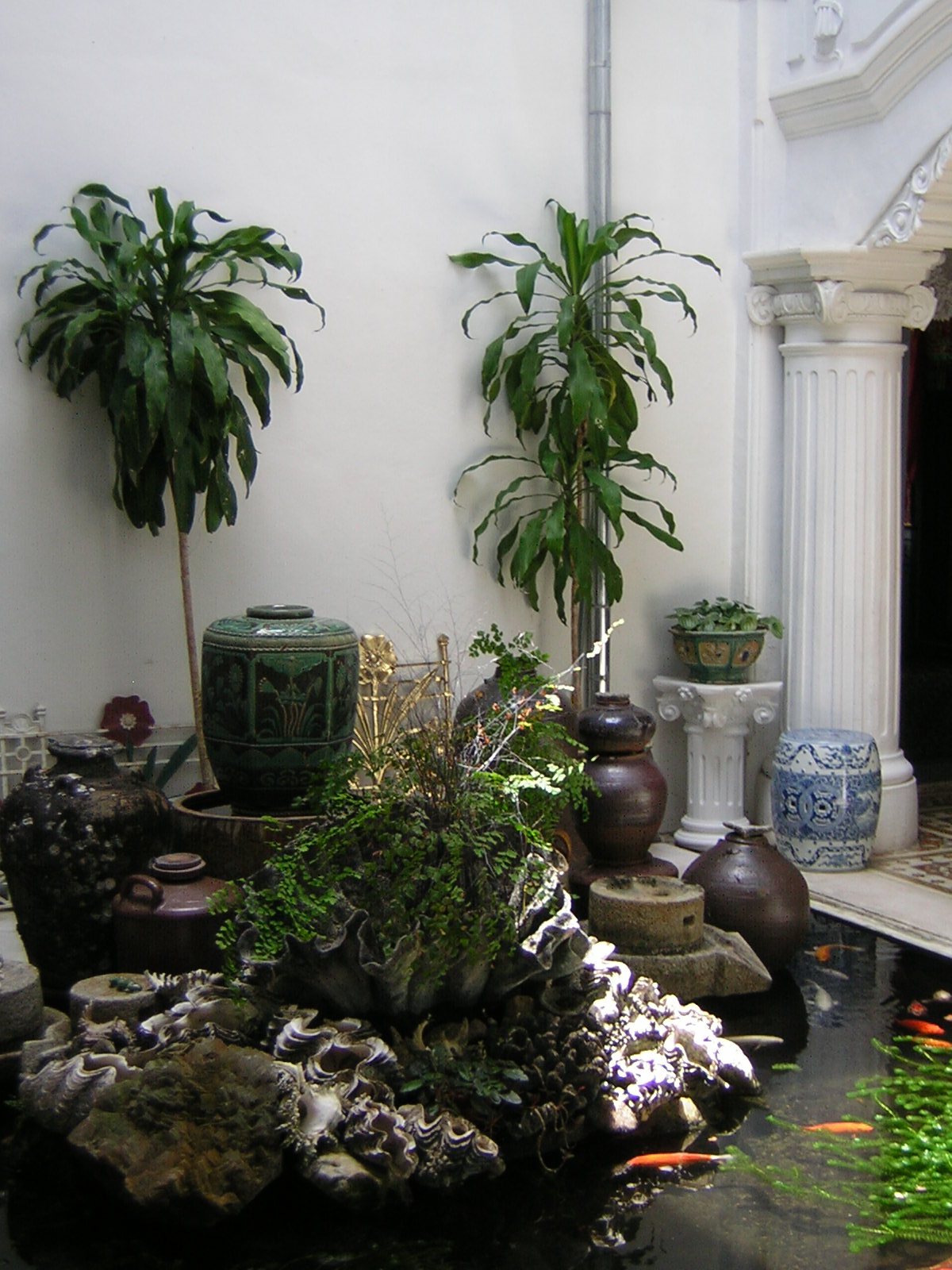
At the heart  is an courtyard and central fish pond, but roofed with a glass ceiling around which the residence branching out. This arrangement gives the house an oriental version of a Classical Roman Villa. Frittered with Quin rosewood inlaid furniture , imported from China during the 19th cent. internal columns and relief plasters all add to the opulent feel.


Central Courtyard.


Inlaid Rosewood Furniture.


The current owner was born in the house, while the children's nursery and a very historic wood fired kitchen still stands in mint condition, another interesting feature is the ceramic wash basin.


Cermaic Washbasin.

Many Chinese were drawn here both rich and poor with the introduction of open cut tin mining ventures [Mhuang Harb] which required large amounts of labour. Many new mines were opened up during the 19th cent. creating numerous Chinese communities. Mining continued until quite recently, only ceasing in 1986 after some 300 years.

Woodfired Stove.

Friday, November 11, 2011

Crete-The secret monestery of St. John the Hermit.


Agis Triada
Quick pencil sketch, Crete. 1962.

Flicking through my draftsman's drawers, I came across a drawing  made several years ago of the church of Agis Triada. An old 17th cent. monastery about 18.5km outside of Hania in western Crete.  The approach to  is down a tree lined avenue of cypress pines opening  out into a large square. To one side ,there is a neat vineyard, pruned to what is called a gooseberry bush [ vines without a trellis], while the other side consisted of an old olive grove. Such scenes are the standard vista in this part of Crete, vines, olives among sheep and goats. Goats supply the music, while  sheep can be relied upon to dance in their sheepish way.

Agis Triade itself  presents the viewer with a palatial facade of warm soft coloured stone. Entering through the Venetian gate, past a large bell tower you are overwhelmed by the strong  scent of orange blossom. Walking on, you come to a grand staircase giving access to the monastery itself, a complex of buildings contained within high stone walls. The church built in 1632 and set in the centre surrounded by an assortment of various structures built over the centuries. Unfortunately, the day Heather and I visited, the church was undergoing major restoration, with the interior packed with scaffolding. The ceiling was painted sky blue with gold and silver stars under the dome, giving the feeling of a vista into heaven. The metal work around the holy of holies had been regilded in gold and was slowly being returned to their former pride of place. There was a small museum ,that housed the remains of an  older monastery destroyed after  fall  of Crete to Turkish forces. I believe every one was killed during the siege, but such is Cretan history, were half her population has been killed every hundred years or so, either by Ottoman or other foreign forces. We decided to walk on the further 4kms, up the rocky track over the mountain to the next monastery of Gouventou.

Our road if you could call it such, wound its way through the rocky landscape, most of Greece is like this, goat tracks running in every direction to unknown villages, surely a partisans or hikers paradise. While the goats bellowed and sheep danced, we passed a memorial cut into the a solid block of marble that seemed to refer to the Cretan partisans who were killed in the last war between 1940-45 . Passing  Gouventou as there seemed to be little of interest , we decided to walk on hoping to reach the distant coast and the beach. Ten minutes later we were passed by a workman and his two dogs, then a rather large rounded monk not unlike Friar Tuck appeared with his donkey. I was somewhat surprised to see strapped to each side of the beast, two milk crates [Bakers milk design] used for carrying supplies.There appears to be no end to the usefulness of these crates the world over. Further on both monk and workman disappeared into a grotto apparently to do maintenance work on the chapel within.

After a further fifteen minutes down the track which seemed now to have been better constructed, we noticed what looked like a ruin on the opposite side of the ravine half hidden in the bushes. It was only then on turning the corner that I noticed the remains of some stone steps among the vegetation. As I descended a bridge like structure came into view bridging the gully. Continuing on down the stepped path in a zig-zag manner more and more buildings started to appear among the under growth. Both Heather and I became quite excited as it was a little like descending into the unknown world of Alice. I am sure archaeologists must feel such excitement on a discovery. Around another bend on the track a Venician Gate stood out side what appeared to be a disused church/grotto cut into the rock face. What was wonderful about this was the total unexpected nature of the whole discovery, we had set out following a goat track hopefully to the beach.


Heather decending the staircase to the Monestery


As we continued to descend into this hidden world ,monks cells appeared ,enclosed in terraced gardens. The remains of bread ovens hugged the rocky gully walls. The buildings on each side of the gorge were connected by the bridge we had seen earlier on. This now appeared to be considerable larger settlement than we first thought, the bridge was longer than it first appeared ,with it's upper level the size of a tennis court. More monks cells appeared built into the supporting pillars at both ends of the bridge ,each cell about three metres by five . They had a breezy window and door at each end, it was only later that I realised that this was to afford a quick escape in the event of danger from the Turks. The cells had barrel vault ceilings, some had stone benches running along one side wall for sleeping. You would need to be very spartan to endure a winter here.


Roof of the monks cells.

At the time, we had no idea what we had discovered and when we asked at the tourist centre they seemed to know even less. Several days later after some research, I discovered that we had stumbled upon the site of the ruins of Moni Katholiko, a monastery delicated to St. John the Hermit who lived in these caves during the Ottoman occupation. The site was also used by other Christians during the periodic persecutions that took place all over Crete, often with tens of thousands being put to death.

Wednesday, November 9, 2011

Bruegel- "The Blind leading the Blind"

The last two blind figures in Bruegel's "The Blind Leading The Blind"


When I first viewed Bruegel's masterpiece "The blind leading the Blind" in Naples, I had been living in Italy for nearly a year, so it's impact was instant. Whether this was due to my diet of sweet Italian paintings I'm not sure, but the comparison of a more brutal Northern European style hit my sensibility straight between the eyes. The sheer economy of paint on canvas gave the work a sense of urgency not found  in Renaissance Italy. The forms seemed to have been created by simply rubbing a rag across the canvas. The result left me somewhat speechless, for I must have stood there for what seemed like an hours.


The more you study Bruegal's master work, the more you see and more importantly feel for it is a depiction of human misery on a grand scale. Each man's inner thoughts seem to be presented in all their despair. The Blind leading the Blind" is more than a mere painting, it depicts in graphic form the cruelty of humans towards each other, while at the same time suggesting a sense of brotherhood. The blind participants express and symbolize various fundamental human conditions.

First figure on right lying on the ground and about to fall into the swamp.


The figure on the extreme right portrays absolute despair. He has fallen almost head first into a swamp with little hope of escape from drowning. Each of the figures are unable to see any reality beyond their inner most thoughts. Their is no dream for them of a better future, already his mouth is open like a drowned man. There is nothing to clutch hold of even if he could see, just water plants and the swamp itself.

Fallen figure.


The second figure falling over him represents hate, his empty sockets gaze menacing out into the void. His hand seems to be pushing the fallen victim towards  the water. A viewer almost feels that he also will follow a similar fate.


Second blind man from right.


Innocence is the next condition, he has under gone much suffering throughout his life. He seems a rather tender sort of man intent on holding the staff confident he is safe, unaware of the drama unfolding before him. His bellowing cloths suggest further misfortune that has plagued him  through  out life..


Figure on right represents innocence.


Following him is the blind beggar representing tragedy. His trusting hand placed on the should in front. He believes he belongs to a brotherhood of similar spirits.The figure behind him is totally attached to both the men in front and behind. His hand falls affectionately on the figure in front, while he holds fast to the staff for his companion behind. He seems lost in thought, listening to their marching feet ,drawing confidence from its regular beat.


Tragedy


Figures five and six, the last represents trust.


The final walker has a child;like expression on his face, he seems to be in a dream state as he drifts along. Nothing from the outside world reaches him as he clutches the staff unaware that he too is condemned to fall.
This painting has a strange spiritual feeling about it, there is a sense of pity, but there is nothing we can do to save these individuals. The philosopher Schopenhauer once rightly pointed out that pity is the ultimate goal of all spiritual seeking. The more compassion we have for others presupposes the pity one would expect from them if fortune favours their future.

This painting in my view is one of the great works of the 16th cent. It presents a universe of personal perception. It presents in graphic form the march of the have no ts of our world as they march along to their fate. In a contemporary sense it is pertinent to our current situation , were the greater mass of humanity struggle to survive. Our political masters are in a way portrayed by these blind men locked in there own personal agendas, unable or unwilling to see were they are going.

Sunday, November 6, 2011

Tasmanian Tiger [Thylacinus cynocephalus]

Watercolour sketch of Tasmanian Tiger by Peter Kreet.

The Tasmanian Tiger over the years has captured not only the imagination of Australians, but many conservatists around the world. Extinct species seem to create both curiosity and the interest of various celebrities, who feel obliged to mount  expeditions into the Tasmanian wildness.  A recent example was Brigitte Bardor, the French 1950's sex kitten. Unfortunately the Thylacine received a lot of bad press, blamed for heavy  sheep loses in the early days of settlement, the settlers applied political pressure to have a bounty introduced. However this proposal only passed through parliament by one vote, mainly due to the likely cost of one pound per carcass. Given that tiger had a preference for open country, there was always going to be a clash of interests with the early farmers. Evidence has suggested that wild dogs were the most likely cause of most stock loss, as the Thyacine diet of mice, bandicoot and other small game was plentiful. The bounty had more to do with the hard economic circumstance of many settlers, than stock losses.

Given this general overview, I was more than excited to be offered the opportunity to visit the Thylacine Vaults at the Tasmanian Museum & Art Gallery. Behind it's locked doors the Museum holds one of the largest collections of Thylacine specimen in the world. Over eighty skins, skeletons, skulls and various bone parts, along with several taxonomic examples are stored in its basement. There are also many preserved young in various stages of development held in spirits. The young when born are required to make the perilous journey to the pouch which fortunately face the back of the animal. Still the young are born without hind legs or hair and live in the mothers pouch for five months until they have grown a coat. The females are smaller than the males, the collection holds samples along with juveniles.

The 19th cent. saw a large trade in tiger carcasses, They were sent to Universities for dissection and traded with other Museums around the world for other exotic animals. Although the scientific community expressed concern about their possible extinction ,they were not placed on the protected list until July 1936, just 59 days before the last Thylacine died in captivity in Hobart's Zoo! The records suggest some 2ooo animals were needless shot for know real reason other than rumour. Settlers on the east-coast of Tasmania  in 1886 went so far as to from an association for the extermination of the Thylacine from the State due mainly to the possible financial rewards on offer. All animals shot had to be destroyed so as to prevent double dipping, sounds very much like the antics of the apple pull during the 1960's & 70's. It would appear that Government money had more to do with the disappearance of Tasmania's unique tiger.

The Museum lead the fight to create a reserve for the Thylacine, under the directorship of Clive Lord but without success. Prices soared as they became rarer like most exotic creatures and  prices have been going up ever since, recently a skin was offered for sale eBay with a price tag of  120000 dollars. We know very little about the life span and habits of the Tasmanian Tiger, whether they lived in family groups [single males had been sighted]. The 19th cent. was very much interested in their anatomical structure  due to Darwin's revolutionary theories, but showed little interest in anything else. Anatomically they are similar to the build of a greyhound which suggest short bursts of high speed. Little about the breeding cycle as non were every bred in captivity, we do know they could have up to four young, although two to three was normal. There is no evidence to suggest they were territorial like a wolf. The tiger was a carnivore with a short digestive track, it's likely life span about 12 years.

Over the years there have been reports of sighting, but no hard evidence has been supplied. Recently a German tourist claimed to have taken a photo of one, the markings seem to match, but the photo is very blurred and he returned home unfortunately before the film was developed. His brother reported the find some time later but no one has ever interviewed the gentleman .May be this was the source for the current film Hunter, were an army of Mafie types are all searching for a tiger. Many artist have attempted over the years to base work on our tiger, but generally they often make the animal appear large and aggressive, when in fact they were very weary of humans, there is no record of anyone ever being bitten.  It will be a great tragedy if our other unique creature the Tasmanian Devil follows the Thylacine into extinction.