Tuesday, February 19, 2013

Francis Bacon.


"Studies for a human body" Section.
Francis Bacon
Many curators and critics consider Francis Bacon among
the most important artists of the 20th cent. An artist whose
main focus was on the act of painting, the manner of the brushwork, and the physical presence of the paint being the all important quality of his work. Bacon's painting are framed under glass, so when a viewer looks closely at work in the current exhibition at The Art Gallery of New South Wales, they become aware of the need to move around from one foot to another. This need for physical engagement is the only way to really see what is going on, the need to move the reflections on the glass in order to fully view the work. This is a deliberate device to force to enter into and connect with the painting. In other words the viewers subjectivity must over ride other conscious interpretation of the image.

Bacon once pointed out in an interview that "in the end painting is a result of the interaction of those accidents
[chance in the process of applying paint] and the will of
the artist or, if you prefer, the interaction of the uncontentious and the conscious".

Bacon stands alone in 20th cent. art, as realist who is not a realist.He was not an expressionist and rejected strongly any suggestions he was. Nor was he an abstract artist, rather he was a realist who was not interested in literal or illustrative interpretation of the world. He loved the element of chance inherent in his paint application. At times he Incorporated sand, sweeping from the floor in his work. Bacon applied paint not only with a brush and palette knife, but made use of rags, and foreign materials to produce the effects desired. He was always looking for the unexpected result.


Bacon was a realist painter in a very loose way, but had the ability for a viewer to recognise the image.He shun ed any idea of story telling and rarely included more than one figure in a painting. These figures were in turn often enclosed in suggestive boxes or rooms that contained them but not completely. He did not what the viewer to be tempted to relate one figure to another. The figures as you can see are in varying degrees distorted, but still recognisable. One is tempted to view his work as violent, but the scenes are not violent so as to force the viewer to experience a raw aspect of reality. To unlock their conscious attempt to interpret the image in some conventional way.

Bacon wanted to counter any tendency to define meaning in his paintings. His aim was to create a new aesthetic through the physical presence of paint. Abstraction for him was a dead end. His art was an attempt to create a
                                                                      new way to lock reality into something arbitrary.


Sunday, February 17, 2013

Ethnicity and Cultural Heritage.


WHAT IS MEANT BY ETHNICITY?

When you ask most people what they are, they generally reply that they are generically what the country of their birth happens to be. Given this type of answer, I have often wondered in this multi-cultural world what exactly such a response means. How do we define who we are? To what degree does an individual’s  cultural, religious and ethnic backgrounds play in defining who they are. This may seem to be a rather academic question, but with the  greatest historic migration of people all over the world taking place the question needs to be asked.

Australia has developed a fairly successful multi-cultural society over the last fifty years. There have been hiccups, but by most standards we have developed for the most part a tolerant society. Anyone living in the country for the required number of years is entitled to apply for citizenship. You may think this is normal, but there are European counties were new comers who have lived for several generations are denied such a privilege, the Turkish population in Germany comes to mind.

In this country there are people from every corner of the world who have lived in Australia for one to two hundred years, many decedents of Chinese miners from the 19th cent .are still referred to as Chinese by some Australians. Afghan camel drivers from the last century are another case in point, but are these people still Chinese or Afghans, I think not, they would describe themselves as Australians.

What we need to look at is not physical appearances, or religion or what  other gauge we like to use, but rather how they see themselves as a part of this country. There is no doubt that various nationalities look back to their cultural roots and background to define who they are. This presupposes that people don’t evolve into something else when resettling into a new environment. Is a Malay Indian, Indian or Malay? At what point does a person stop belonging to one ethnic group and takes on the ethnicity of another. In reality every national group is a mixture of different cultures created over thousands of years.

In the end it is cultural practice that determines one’s ethnicity, how you see yourself. The original indigenous inhabitants of Australia are a good example, the vast majority are of mixed blood, some no more than one quarter indigenous, yet many disregard such genic material. This would suggest that majority genic background as far as they are concerned does not play a defining role. Religion can likewise be dismisses as most religions are all embracing no matter what your origins. Countries that like to see themselves  “racially pure” are no more than the result of migrations over the millennium. People who still like to think in such fixed terms need to take a cold shower. We should all be alarmed at the rise of groups who for whatever reason view multi-culturalism as something to be abandoned and distained. All societies are multi-cultural whether we like it or not. The formation in Australia of a political party recently advocating assimilation and the abandonment of the multi-cultural nature of the country need a serious rethink. Everyone has the right to see themselves in their own terms, and providing they live by the countries laws no harm is done. Eventually all will all become one.

Saturday, February 9, 2013

BOOK LAUNCH.


BOOK LAUNCH”

In this day of e-Books and other forms of electronic information there is a danger of the book launch being consigned to history. However, the other day I had the pleasure of attending the book launch of a local author at the Hobart Book Shop. The mere fact that an eighty year old could find the energy and dedication to write a first time novel at that age was a marvel in itself.


The author Paddy Burges Watson, has set down a wonderful tale of a young poor Irish girl from Connemara, who through misfortune finds herself transported to Van Diemen’s Land. The tale embraces years of social observation about the emotional and physical reactions of our human kind. Set in the 1820’s it offers an insight into the early years of Hobart from a humble perspective.


Sitting in the bookshop listening to various speakers endorse Paddy’s tale, my eye wondered around the shelves alighting on volumes of diverse subjects. Books on the romance of travel, how to cook exotic dishes, latest novels , philosophy and on. Some occupying their allotted space, while others had managed to arrange themselves randomly on top of shelves or on the floor. What a great loss to mankind would result from the disappearance of that physical entity called a book and the bookshop itself. Feeling their weight, the smell of printed paper as you turn the pages with a real expectation of what is to follow.


Watching the crowd eagerly line up to have their new found friend endorsed by its author, sitting patiently at his table. That sense of comradely life  as they joke and laugh among themselves. These experiences cannot be replicated in a computer world, and our world would be a poorer place. As for the book’s title “Moving On”, This reminds me of anough friend who claimed ther was no need to worry about the world as eventually we simply move on.

Wednesday, January 23, 2013

Public reaction to Public Sculpture.


"Bright Prospect"  painted steel 1979.
Ian McKay.
This type of public sculpture were placed in most towns.
Unfortunately they do not have the life or humor of that great American sculptor David Smith.


Public Sculpture.

Alcibiades rampage through Pericles’ Athens in the  fifth century ,after a heavy night’s drinking set a pattern. His lopping off the genitals of sacred statues, and general defacement of public sculptures seems to have repeated itself in various formats ever since. My first contact with this past time took place in the Archaeological Museum in Athens, were the statue of a Roman Governor’s wife appeared to have been stoned. It would appear that she was greatly disliked to say the least, and on her death the citizens literally stoned her bronze likeness. Not that the Romans were the only targets. A statue of Demetrius [The Besieger] was also torn down during what became known as the smashing period around 200BCE. The Athenian simply were fed up with Macedonian rule.


The general public has taken this idea to heart and continued to take out its vengeance on statues of overthrown rulers ever since. Over the last few decades, we have seen such activity directed towards the portraits of Stalin, Saddam Hussein, Pol Pot among others, as well as sculptures of a non-political kind. Why the public take such  personal views of  public  sculpture has many reasons. Often they did not like the politics, ideologies expressed, or simply the aesthetics of the work. I don’t pretend to be a sociologist, so am unable to offer any definitive answer, but history abounds with the wholesale  destruction of public sculpture. Often every time there is a change of government certain members of the public go on a rampage,


A local Australian example of this attitude was the removal of Ron Robertson-Swann’s large painted steel sculpture in what was to have been Melbourne’s city square. Standing some 5m high, it allowed the public to traverse under the vaulted canopy. Painted yellow it was quickly christened Yellow Peril . Council opponents felt it “would turn small children blind and would provide a place for sex-perverts to hide”. The sculpture did not last long and was removed in pieces to become a “artistic heap” on the banks of the Yarra. The example of this type of works is illustrated above in the steel sculpture of Ian McKay. Why people should feel so strongly is hard to fathom.


What interests me is why do the public react so strongly towards 3deminisal art work. Generally they don’t [well not in recent times], react in the same way to paintings in Art Museums, well not in more recent times. Art exhibitions do not have the same political clout as they did in the 19th cent. Over the centuries public sculpture has been used for political and religious purposes, so we must assume that people view sculpture work displayed in public areas as propaganda. Have you noticed how often public art has a hidden meaning. Often the subject is such, as to suggest that a Government really cares about the subject. It may be the environment, or the claim to territory, or simply the grandiose claims of political masters. I have included a couple of local examples we have here in Hobart.  One concerns Australia’s claim to large areas of Antarctica, while another records the discovery of Tasmania .

                                In support of Australia's claim to areas of Antarctica.

Lastly, there are war memorials about which there is universal respect, and images of Kings and Queens, Public Figures and so on. Often these are also defaced for no real purpose, other than one assumes to express a person’s disagreement with the message being conveyed, and make them feel good! It is little wonder that sculptors feel the need to use materials of substance, for such works must withstand the full gambit of human emotion and response to something foreign in public  “space”. It is impossible to please everyone in matters of ideas, and taste, after all the public sees public areas as extensions of their homes, and as such feel at liberty to remove, alter, deface, or destroy sculptural works as they see fit.

                                  Abel Tasman's ships, on the discovery of Tasmania.

Monday, January 14, 2013

Gympie Pickers and life in the outback.


Gympie Pickers.
 
January marked the arrival of the Gympie pickers, an Australian equivalent of the itinerant agricultural labour of Europe. They started  their travels in Queensland with the harvesting of the early vegetable  crops, slowly moving south picking a variety of fruit and vegetable  crops on the way. At the time, and this was some forty or more years ago, my wife and I used to grow various cash crops such as carrots, onions, and so on. These crops in those days were harvested by hand, and if your farm was isolated you depended on these itinerant workers.
 
Gympie, a southern Queensland vegetable growing area  supported a year round industry, resulting in a large pool of unskilled labour. Many of these families were basically marginal, existing on unemployment benefits and what  ever they could earn on their yearly migration south. Generally they had large families, six children or more not being unusual, not that the children ever seemed to go to school. They spent a large portion of the year on the road, living in caravans, tents,  some hitch hiked and slept under trees or bushes not unlike the swaggie of old.
 
Most years we would grow some forty or fifty acres of onions that required hand harvesting after drying off. This involved lifting the crop by tractor, then the pickers would pull the onions out of the ground, top and tail the roots and stems with sharp shears. It was not unusual to have up to sixty pickers on the block during harvest time. The control of such unruly numbers often proved to be an art form in itself. Mum, Dad, and the kids would arrive in an assortment of transport. Dad would hand out the sharpened shears ,then they would  set to work  pulling at the onions. Often I would become quite alarmed at the age of some of the “workers”,   fearing they would seriously hurt themselves. They all worked as piece labour, meaning they were paid according to the quantity of crop harvested. In a sense they were independent contract workers agreeing to a price per ton harves
Each family worked as a team, although Dad often took a few breaks to refresh himself with a beer. Often the temperature at the time of the year was in the forties. They would get up to all sorts of tricks. Half filling an empty bin with the onion tops, then placing a thick layer of onions on top. Unless you dug down fairly deep into the bin you would never know. They were full of ideas as to how to extract money without working. Another problem was their name, they always wanted a different name every other days so as not to interfere with their unemployed benefit.

Another major problem was communication, they had a language all of their own, and had great difficulty stringing more than a few words together without several explicit profanities in between. One year we heard on the radio, that the police were looking for a man who had love tattooed on the fingers of his right hand. Apparently he had just murdered a woman in Sydney. Sure enough there he was out in the paddock, happily harvesting onions. My wife noticed him first, and after making eye contact both knew that the other knew who was who. My wife quickly returned to the house to phone the local police, but needless to say he disappeared in a matter of minutes. 
On another occasion a picker demanded payment in advance, and followed my wife back to the house where he tried to bar her entry by placing his arm across the stairway. At the time we owned a retired Doberman police dog who was quietly sleeping in the shade of a nearby tree. On noticing what was happening he leaped at the man's throat, and in no time had him on the ground. On release our offended picker quickly took to the highway never to be seen again.
Such were the joys of cash cropping in  outback  Australia, and the labour you needed to harvest it. This  property was many miles to the nearest town, so you just had to put up with who ever you could get. Eventually the pickers finished, packed up and headed further south following the seasonal  cropping patterns, not to be seen again for another year. We just sigh in relief, another harvest  completed.


Thursday, January 10, 2013

A Ships Final Voyage.


"Homeward Bound"
Acrylic painting by Peter Kreet 2013
1000 x 700


Every now and  and then artists  try to create  new visual feelings in a painting by experimenting with a new approaches. Over the last two weeks, I have create three marine paintings for the Hobart Wooden Boat Festival exhibition next month. The idea was to create a dramatic effect and feeling of the power of the sea. In order to achieve this, I introduced two different view points to create the necessary tension. Not in a cubist manner, but straight forward rending of the subject, by  turning the stern end of the ship  upward and away from the viewer, while the forward bow  of the vessel has been turned down to create the effect of a contraction..This devise  resulted in heightened sense of tension, creating a wringing out feeling on the part of the viewer. It is almost as though someone is wringing out a large sheet in the pre-washing machine manner.


I am quite pleased with the result and shall attempt to expand the idea, firstly through a maritime series, and later with slabs of daily life, and relationships between people.Hopefully the coming year will be rewarding in a creative sense. This is what I really enjoy about creative activity, no matter what a person is attempting to undertake, the joy a thrill of experiencing the unexpected is very invigorating.

Wednesday, January 2, 2013

Cloisonnism, a reaction to 19th cent. Impressionism


Emile Bernard "Breton Women on a Wall"


Cloisonnism and 20th cent. Art.

Cloisonnism should be regarded as one of the pivotal ideas in the development of 20th cent. painting. It could be regarded as one of the major concepts of several Post-Impressionist artists in their search  for a new  direction away from Impressionist painting. The focus on colour and fleeting play of light had dissolved the ridged internal structure of painting, the idea of reintroducing solidity into their work appealed to several artists around the 1880’s. Van Gogh and Gauguin were two major exponents.  Emile Bernard, Louis Anquetin, and Toulouse-Lautrec among others were early pioneers of the style


French 13th cent. Stained Glass Window.
 

Katsukawa Shunko
"Head of a male Actor" c. 1784-8 Woodblock.
Collection: Mannendorf Amstntz .
 
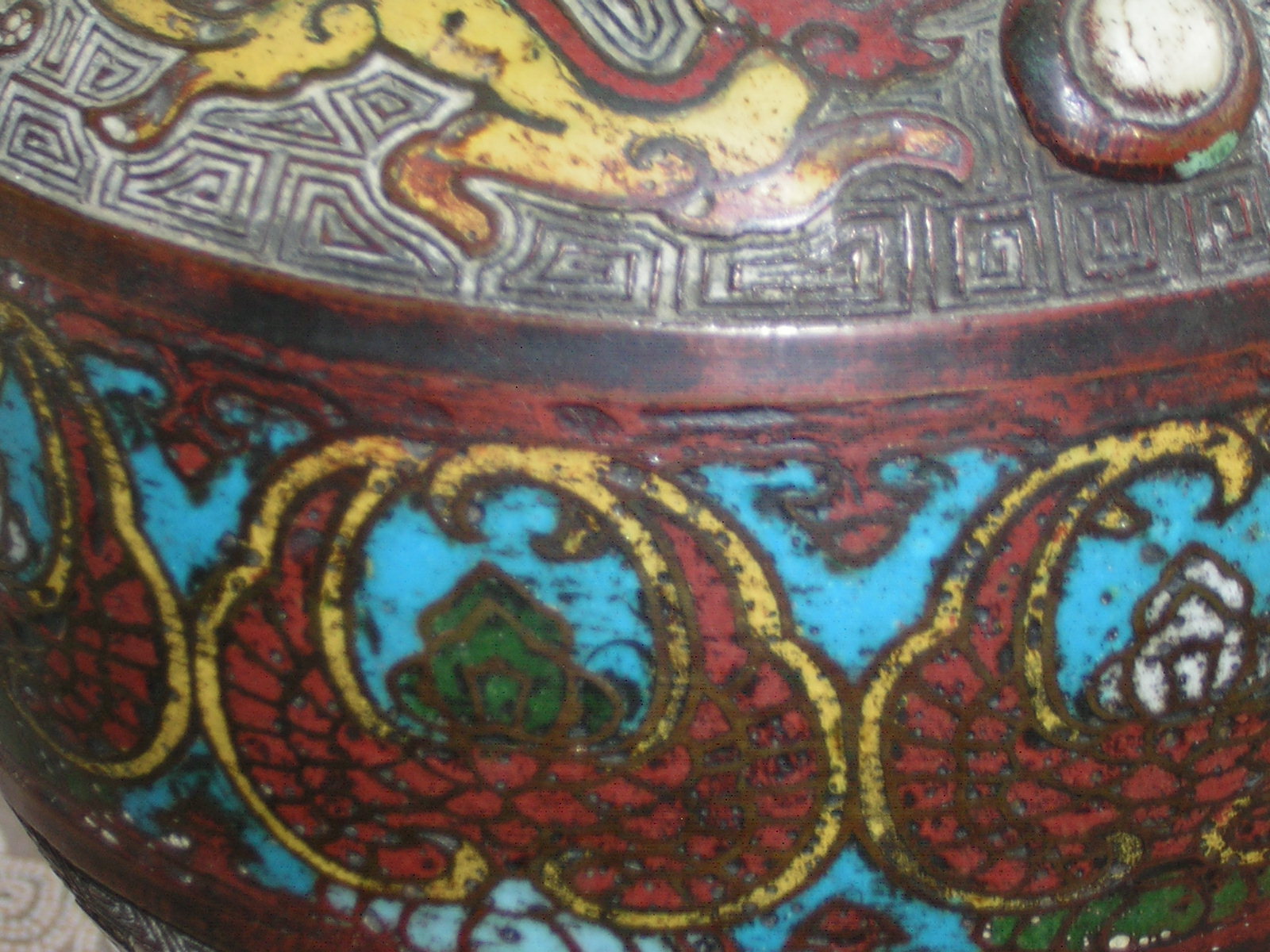
In their search for a solution these artists turned to two Oriental art forms for inspiration, namely Japanese woodblocks [that were very popular in Europe at the time] and cloisonné a technique still used today in craft work shop in Asia.  This technique requires the separation of enamel colours to be separated by the use of fine metal lines soldered onto the object. Another source of inspiration available was the stained glass windows of Gothic cathedrals.

Cloisonne Censer, Ming. [detail]
Mark Hugan Te
 

The idea of separation is quite obvious when we examine the above examples, with stained glass you will notice how the intensity of the coloured glass is heighten by the lead tracery that holds the piece together. Likewise each colour change in a Japanese woodcut required the cutting of a separate wood block,   resulting in the creation of distinct and separate colour and textured areas within the work.


Emile Bernard
"Breton Women in Meadow"

Paul Gauguin
"Vision After the Sermon, Jacob Wrestling with the Angel"
 
 
Vincent Van Gogh
"The Arena at Arles"
Hermitage Museum.
 

Vincent Van Gogh
"Ladies of Arles" [detail]
Hermitage Museum
 
 
I have selected a number of examples of visual works to illustrate how the painting of dark lines around areas  intensify colour, and how various artists of the late 1880s influenced each other in their search for a new approach. We only have to compare the two following artists , one a painting by Bernard “Breton Women in Meadow”, and Gauguin’s “Vision After the Sermon” to appreciate the singularity of their vision in searching for solutions. Another painting by Van Gogh’s “Ladies of Arles” also demonstrates his interest in this idea. If you compare these  artists  works with a detail of Monet’s “Corner of the Garden at Mondgeron” you can grasp what these painters  were attempting to achieve.
 
Monet
"Corner of the Gardenat Mondgeron" [detail]
Hermitage Museum


Monet
                                                      "Poppy Fields" Hermitage Museum
 
Pablo Picasso
"Seated Women"
 
The idea of Cloisonnism however did not stop here with the Post-Impressionists, but was taken up, and further developed by many artists as they developed other major art movements during the 20th cent.  Even though many different artistic , and  aesthetic  visions that were to follow, Cubism. Expressionism, Abstracting to name just a few, plus all the other isms of 20th cent art . The idea of  Cloisonnism in painting continued to be developed and appears from time to time depending on the  artists  intent in modern art.
 
Otto Muller
"Seated women"
Frau Maria Helsig Collection, Kiel.
 
Pablo Picasso used the idea widely as his “ Seated Women” painted in 1927 confirms along with many of his other ideas developed from Cubism of his interest.  Later still we find the technique being used by the German artist Otto Muller in his “Seated Women”. Here the use of the devise Cloisonnism greatly enhances the dramatic  impact of  his painting, so the technique could be used for other purposes. This continual use of this old idea has played no small part in the development of 20th cent.  art,  and in my view deserves greater attention in any survey of the art of our time.