Monday, March 3, 2014

Where do we find home?


What do we mean by Home:


With half the world’s population apparently in search of a new homeland, the question arises as to what qualities or lifestyle a human being seeks in finding a place they may call home.

Naturally most people consider home the place or country in which they were born as home, their motherland or fatherland as the case may be. Over the centuries peoples have travelled far and wide the search of some illusive quality they consider desirable. Historically it would be fair to claim most moved either for economic reasons [overcrowding,. better hunting or cultivation of crops, forced removal, ] and so on would cover most of the popular reasons for leaving your birth place for the unknown.

How applicable are all these reasons in the international world of the 21st cent., were we are witnessing the redistribution of ethnic or religious groups on an unprecedented scale.

Although it could be claimed that the relocation of an individual is less stressful than say a family group, the heartache is often the same. Moving in today’s world is often associated with conflict and assimilation not always assured.

To return to individuals on a more personal level, the meaning of home has different meanings. There are different words to describe this state, homelessness, homesickness, exile, alien are simply a few. To be homeless is self-explanatory to live on the street needs no explanation, but to be homeless may also mean stateless that to some extent means the same thing, you have nowhere to go.

Homesickness is entirely a different proposition, it presumes you have left your birth place for some reason, economic, adventure, or it just seemed a good idea at the time to go to some foreign or distant location, a place that does not qualify as the village down the road, somewhere exotic the unknown.

One of the strange conditions about homesickness is that there is often a reoccurring desire to return “home” in later life. This is particularly noticeable here in Australia were some 40% of the population are foreign born. You would imagine that regular visit to their homeland would quell this thirst for home, but this assumes that “home” remains the same, which of course it doesn’t.


Over the years I have spoken to many migrants who after living here in Australia for many years still don’t feel fully at home here. Sometimes due to cultural customs, the landscape, language, lack of contact with their stay at home relatives. Yet when they return home after years of absence, find they no longer relate to their mother country in the same way as before. Often due to new economic circumstances, migration or new political developments, nothing unfortunately ever remains the same. Some migrants who have taught their children their mother tongue find that their native language has moved on, and their version has become rather dated in their mother country. To some extent they have become stateless or citizens of the world belonging to no country in particular.

I often feel much of the dissatisfaction in their lives is due to this condition, that they no longer belong anywhere anymore. They belong to no country that they can truly call home, in the true meaning of the word. All of us set out on the adventure we call life without sufficient consideration of the long term consequences of our decisions. To further complicate our desire to belong somewhere there is the problem of marriage between different ethnic groups, now some 30% of the population marry into different ethnic groups, creating a new people a refinement that appears to focus immigrants on their new country, their new homeland as this is now the mother of your new life.

Monday, February 24, 2014

Moorish Spain's Cordoba Magic.Mosque or church?.

Interior Cordoba Cathedral.

Cordoba Magic.

Nothing quite prepares you for the magic and impact of Aljama Mosque’s labyrinth of columns that greet the visitor on entering Cordoba Cathedra in Cordoba. No photo can ever do justice to the sheer beauty and simplicity of this building as the sea of tiered columns stretch away into seeming infinity.


The world’s largest Islamic monument and I believe third largest mosque conveys a feeling of spirituality that is almost impossible to ignore or explain greets you. Such is this impact of the interior that the Christian church built within the walls after the Moorish departure from Spain fail to create a similar feeling. The integration of Gothic and Baroque architectural detail although sensitively handled to complement the Moorish arches fail to convey the same sense of religious purpose. I must confess I am not a great devotee of Spanish Catholic church building that always seems to me overly indulgent.


This display wealth and self-indulgence fails to inspire the same spiritual qualities as the mosaic Mibrab wall at the far end of the interior. The aesthetic impact of both Mibrah and Maqsura hold and transfix the majority of onlookers despite the abstract nature of the design. During my visit this section of the building by far attracted the most visitors. These wall appear to overpower all the Catholic statuary and religious painting crammed into every available space. Gold is all very well and no doubt displays a feeling of security, but it also conveys a greater concern about self-importance than religious belief. 

I spent the several hours in this wonderful building drawing and just sitting among the sheer beauty of the interior. However It is a great pity that the Catholic Church has neglected to maintain the building exterior walls were large sections are in a state of slow disintegration.


Wednesday, February 19, 2014

The Musical Truth about Wolves & Dogs.


Located near Antequera in Southern Spain there is an establishment that specializes in Wolves.
Yes wolves, were on the nights of the full moon visitors may experience various groups of singers
in full throat.
The experience reminded me of my own personal howling nights, when my two dogs would join me
in a sing-song. At the time I was trying to learn to play the piano accordion and would diligently practice for an hour or so each night. Eventually my four legged friends found me and would politely sit at my feet and howl as soon as I started to play and wishing to offer their support. Eventually when ever I picked up the instrument they would come running anxious to join the concert. I'm not sure whether they were man's best friend, but definitely an art event.

Monday, February 3, 2014

Art Nouveau and Deco in Salamanca, Spain. A replacement for cheap mass production.

                                   Front view of Salamanca's Museum of Art Nouveau & Deco Art.


Museum of Art Nouveau & Art Deco in Salamanca, Spain.


Tucked away down a cobble stone street I discovered this little gem of a museum housed in an Art Nouveau Mansion.  This new art developed out of a desire to find new possibilities and design solutions inherent in each material towards the end of the 19th cent .Built by Don Miguel de Lis, a Salamanca merchant the palace seems to be a perfect home for these defining art movements of the late 19th. and early 20th cent. The palace boast’s an exhilarating stained glass ceiling in the entrance reception room, a display of colour and movement. Then on the western side of the building overlooking the river another wall of stained glass that has to be seen at dusk to fully appreciate its full beauty.


                                                                    Museum ceiling.


The palace like many aspects of life had fallen into disrepair before civic authorities in Salamanca restored it in 1992, creating this unbelievable museum delectated to Art Nouveau and Deco Art movements. Don Manual Ramos Andrade generously donated his collection of these periods decorative masterpieces giving birth to this museum. This gem of a place must be one the must see sights not to be missed by any visitor. It holds a fine collection of Chiparus Preiss and Poertzel bronze and ivory sculptures, along with Hoffmann and many others. The Preiss figurines of carefree dancers of the  music hall period between the wars are well represented. These bronze and ivory sculptures are because of the materials of which they are made are one off art works, bronze castings but hand carved ivory additions. The Romanian artist Demetre Chiparus who settled in Paris produced an extraordinary range of sculptures inspired by the dance performances of Diaghilev’s Russian Ballet Company. These images present a fitting image of the new modern women of the times in her new sense of freedom.


In addition to the sculptural collection, the museum contains a defining display of period art glass and porcelains, both figures and functional objects from such workshops studios of Rene Lalique and Emile Galle all add to the museum reputation. This is a collection that Salamanca must be proud of and personally I can’t  speak too highly of it. A visit to which should be a must to any art lover to Salamanca.
I would like to acknowledge the following photos taken from the museum book Chryselephantines
 
                                       One hundred pleats by  Chiparus. bronze, ivory, marble.


                                        Egyptian Dancer by  Chiparus. bronze, ivory, marble.


                                                               Starlight. by Chiparus.


                                               Pierrot by Hoffmann. bronze, ivory, marble.


                                          Chinese Pheasant by Lorenzl. bronze, ivory. onyx.


                                                Flute Player by Press. bronze, ivory, onyx.


                                             The Cigarette by Gory. bronze, ivory, marble.


                                           Knife Dancer by Hoffmann. bronze, ivory marble.


Thursday, January 23, 2014

Spain's Salamanca, the Hobart conection.

                                       Salamanca Place named after the Battle of Salamanca.

Tasmania's capital Hobart was founded in 1804 during the Napoleonic Wars, so it was inevitable that important events would be recorded for future generations from these conflicts. The exploits of Wellington recorded in the naming of the city's  mountain backdrop. Mt Nelson  an inner city suburb, a reminded of Horatio Nelson's greatest victory against the combined French and Spanish fleet at Trafalgar [ Trafalgar Place] another Hobart landmark. The list is quite extensive Montpelier Retreat, Napoleon Street and of course the battle of Salamanca 1812, Duke of Wellington's victory in the Peninsular War when he drove the French out of Portugal and Spain.

                                                     Hobart's backdrop Mt. Wellington.

Salamanca Place a major market and entertainment area on Hobart's waterfront and is central to peoples idea of our city. I have often wondered what the original Salamanca looked like, I knew the city housed one of Europe's oldest and most distinguished university establish in 13th cent. and was quite beautiful. As a fairly inquisitive individual I felt that if ever the opportunity presented itself I would grasp it with both hands and visit. I had no visual picture of Salamanca and the ancient Roman town did not disappoint. A city of rich Renaissance architecture in golden coloured stone, of narrow cobbled streets, secured squares and  intense voices of its student population of around 50000. Central to the old town is Plaza Mayor one of the largest and grandest in Spain, a square boarded by cafes, bars and restaurants, and the stage for local events not dissimilar to Hobart's Salamanca Place and Square. The old warm stone buildings, narrow streets complete with a 1st cent. Roman bridge with few buildings more than a few stories make the town a walkers delight. This was the border territory between Moorish Spain and Christian Europe that ran along the hilltops on the other side of the river.

Looking across to the old town from the Roman Bridge.
 
 
A University faculty.


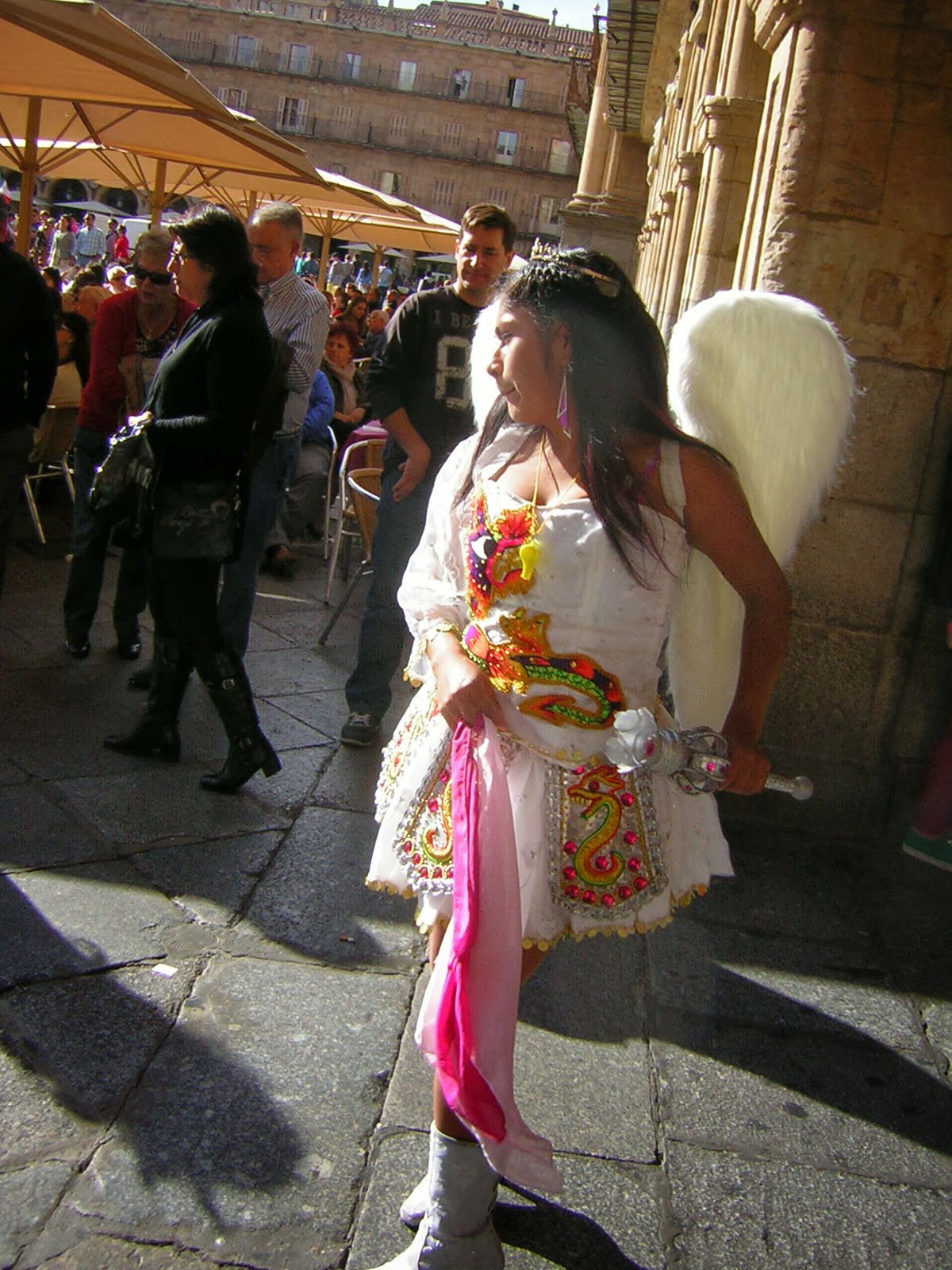
During my stay there, totally unexpected tome the annual Dia de la Hispanidad 12th October festival took place. The event commemorates Columbus's discovery of the Americas. The day turned out to be full of surprises starting with the playing of drums that drifted into the hotel room. At street level  the magnitude of the day  were apparent, various ethnic groups from all over the Spanish world in full national dress danced up the narrow streets to Plaza Mayor to take part in some sort of competition. Peruvian, Venezuelan, Chilean, Argentinian, they all seemed to be there dressed in an array of exotic costumes playing any array of musical instruments. As the day progressed the various groups performed national and folk dances, often there seemed to be more than one group of dancers dancing at the same time. The atmosphere was a little chaotic, but the crowd did not seem to mind. Whether many of these groups now lived in Salamanca I have no idea for all I know many may have been students here to learn classic Castilian Spanish.


One young women performed a sort of flamenco dance in bare feel accompaniment of three drummers much to the delight of the crowd who responded as though at a bull fight. It was just as well she had her drummers as her feet would have been unable the stamp the beat, her act was quite exceptional. All the groups were dressed for carnival, young and old, male and female, all danced as though their life depended on it. Many costumes were from head to toe and quite out of this world. The day finished around 8pm and the Plaza returned to normal. The day had been so unexpected and was all the more pleasurable for that.

Dancer entering the Plaza.
 
Dancer group entering the Square.
 
Entering Plaza Mayor.
 
Solo Dancer.
 
Costumes to kill for.
 
Looking across Plaza Mayor Salamanca.
 

Waiting their turn.
 
Relaxing after another hard day!


Thursday, January 16, 2014

Cygnet Folk Festival 2014


Cygnet Folk Festival 2014.


On the other side of the hill that raises behind my home lies the small Tasmanian town of Cygnet, a town that has over the years reinvented itself as it has moved its focus from a purely rural town of local farmers to becoming a centre of sorts for the creative arts. Each year Cygnet holds a Folk Festival now on its 32nd year, and over time the quality of the performances has continued to grow to the point that the Festival now has an international reputation. I must confess that over the years I have not taken as much interest in the events as I should, confining my visits to the free performances and the craft and food stalls that seem to be heart of such Festivals. Events that are scattered throughout the town over the three festival days, some of questionable quality and have wondered at times what all the excitement was about. This year I decided to buy a full day ticket and listen to  events that are held in the various halls.  This year there were some 120 different performers drawn from around the world and it would be impossible to classify all  the styles and quality of their music.


Naturally, various acts appeal to different tastes and with this years Festival’s theme of World Music the task of what to visit was not an easy one. Many of the musicians held workshops and master class in addition to their performances. Personally I felt four groups stood out, well from the ones I heard. Horse and Wood, a recital by Mongolian, Bukhchluum Gangbured and John Robinson was one they produced some amazing sounds. The music could best be described as a mix of Arabic Mongolian, Scottish mix jazz and heaven knows what. Bukhu sang with a mixture of deep throat vocals switching to different stunning sounds of singing that you would have to describe as amazing while playing his Mongolian guitar. The effect was quite unworldly, whether this is a traditional type of singing in his country I do not know, but it underlines the tremendous diversity of cultural life now present in Australia.


Mara Trio whose throaty rendition of Balkan, Turkish, and Bulgarian songs, struck a cord with the audience. To my ear she had that untrained voice from the throat rather than the lungs so much loved in Romania. Nicholas Lens’ Latin Mass, Flamma Flamma that I heard a few years ago had the same quality. He used some untrained Romanian female singers in the mass to produce this haunting sound that stays with you almost for ever.


The two headline acts, one the Afenginn Group from Denmark, fresh from having just won a Best World CD award, and other Gordie Mackerman and his Rhythm Boys were the crowd favourites. The Danish group had a wider range of musical repertoire moving from soul music to full jazz. The Rhythm Boys however were hard to beat in performance presence. This Canadian group from Prince Edward Island played a vibrant bluegrass jazz. At first I thought Gordie the violinist was Irish, a thin young man who could dance on rubber legs, play music plus held the audience spellbound. He was able to extract sounds from his violin that I am sure Stephane Grappelli would have been proud. Their music had that Tigar Rag quality so much loved by  early jazz fans. There were times when the floor seemed to be moving as much as the violinist from the tapping of so many feet. How Gordie is able to dance, play at such a tempo at the same time begs belief. These were for me the standout performers and the Cygnet organising committee for this Folk Festival need our congratulations for enticing these musicians to our little island at the bottom of the world.

Thursday, January 9, 2014

Karabagh a nomansland?


                                  Grandma and grandfather monument. We are our mountain.


Armenian Karabakh.


Standing on the hilltop of Shoush, it is easy to see why the capture of this strategic town was so important to Armenian success in their struggle for independence. Evidence of war is still all too apparent in this small town where bombardment scares are worn like badges on buildings. Looking down on the roof tops of Stepanakert from this height it is little wonder that this tempting target was subjected to almost constant rocket bombardment on a daily bases. Historically Shoush had been the centre of Armenian and Azeri art and culture and in the 19th cent was one of the largest towns in the Caucasus, but now sadly has been reduced to a mere 3500 souls. The capture of this town in the middle of the night in a daring raid had been the turning point in the war. The operation took place on 8-9th May, 1992 under the command of A Ter-Tadevosyan who led a body of Armenian commandos in scaling mountainous slopes to reach the hilltop. Sadly he died in the battle, but the bold enterprise proved successful. The commandos had built their own rifles that may be seen today in Stepanakert Museum. At the time the undertaking was considered crazy, but such was the inner strength of the Karabakh population no obstacle was too great in their struggle for independence.. A memorial to the fallen in the form of a captured tank stands by the side of the road as you return to the capital. The town was significantly damaged during the conflict and only recently has restoration taken place to the Ghazanchetsot Cathedral, while many buildings still wait their turn. The operation was codenamed Wedding in the Mountains a name that has a great significance as annual mass weddings are held in Stepanakert in the hope that some of the newlyweds will settle here. Nagorno-Karabakh is home to only 150000 people, so population building is a high on the agenda. This Armenian enclave inside Azerbaijan is still awaiting some sort of peaceful mutual settlement, but like so many things in life politics gets in the way. Life goes on however and much building has taken place in the last few years, large squares and tree lined streets give the town a pleasant feel along with several substantial buildings.. One new development has been the construction of ‘ wedding steps’, a broad large staircase lined with brides on one side and grooms on the other in the form of street lights, a rather novel and amusing sight. The town itself is typical Armenian, built around its market and central squares, the general impression the visitors gets is one of struggle and hardship for the people who live here. I did notice the temperature was considerably colder than Yerevan which would have to be expected given the regions height above sea-level, a light fog veils the town most mornings.


                                                Road to Shoush. Heather and the tank.


Foggy morning.


Stepanakert boast a fine museum that is well worth a visit, it allows the visitor to gain a better understanding of their struggle for independence, among the military exhibits such as the handmade rifles are various other ingenious weapons. The museum also houses items of historic interest, carpets, ceramic, clothing etc. In order to gain a better understanding of the current situation we drove up to the Askeran Fortress and on to Tigranakert archaeological site. The road took us through the destroyed town of Asterin with its field of destroyed tanks among shell craters near the Azerbaijan boarder. The town itself is now deserted with its destroyed houses standing forlornly in shadow among the tanks. The Tigranakert Museum contains a number of ceramic objects dating from 1500BC to more recent times. Unfortunately the site is not registered as a heritage area as it still stands in no-mans land, there are still large areas near the border where visitors should tread with caution. 

Mass weddings in Stepanakert.


                                                             City market.


Bride street lights.


On our drive back to town we pass a massive sculpture carved out of the local stone. It represents two elderly Armenians reinforcing their claim to be the true mountain people , The image is reproduced on many items sold to tourists.